
Best Portable Espresso Maker: The Complete 2026 Guide for Coffee Lovers on the Go
Finding the best portable espresso maker can genuinely transform your coffee experience, whether you’re camping in the backcountry, grinding through airport layovers, or simply refusing to settle for bad office coffee. The market has exploded with options ranging from hand-pump manual devices to battery-powered electric units that heat their own water — and picking the wrong one is an expensive mistake.
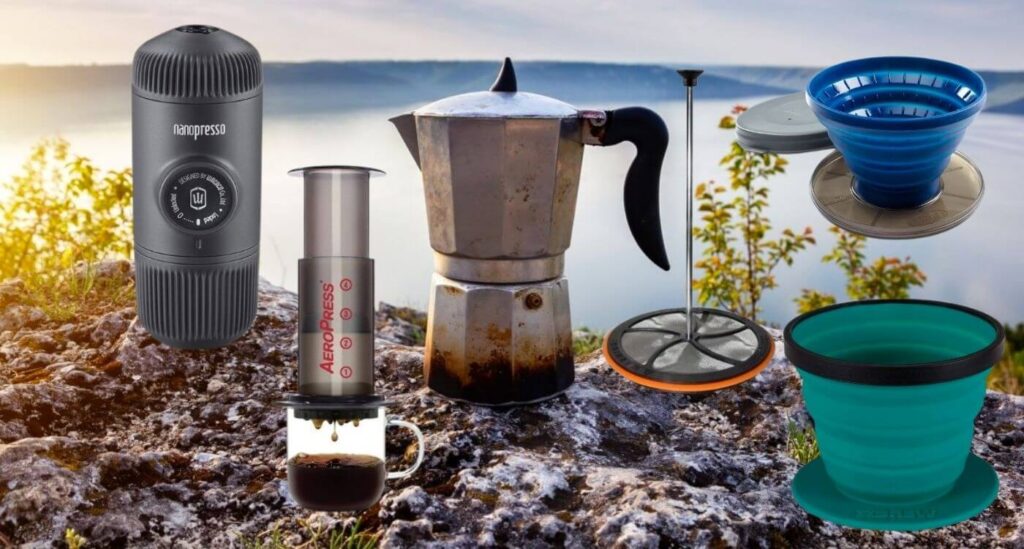
We’ve tested, researched, and compared every major contender on the market through 2026. This guide covers everything: pressure ratings, weight specs, espresso quality scores, cleaning routines, and the exact scenarios where each machine thrives or fails. You won’t find generic filler here — just real, specific data to help you decide.
Whether you’re a seasoned home barista or just starting your espresso journey, this pillar guide serves as your definitive resource for the entire portable espresso category. Let’s get into it.
What Makes a Great Best Portable Espresso Maker in 2026?
Pressure: The Non-Negotiable Metric
True espresso — by definition — requires at least 9 bars of pressure. Most quality portable units now reach 15 to 20 bar, which is actually more than many entry-level home machines. Pressure consistency matters just as much as peak pressure; a device that hits 18 bar for two seconds and then drops off won’t produce the same extraction as one that sustains it throughout the pull.
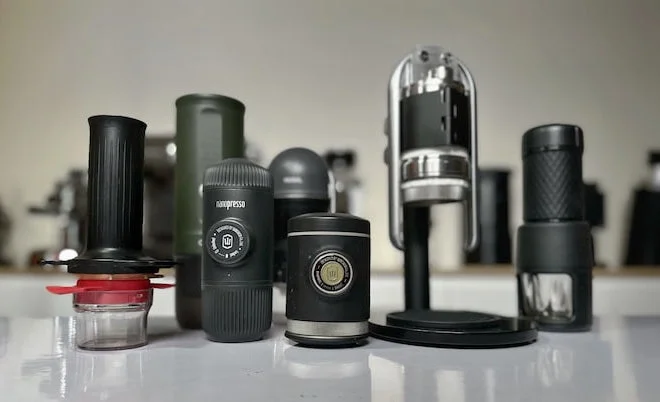
The Wacaco Nanopresso generates a consistent 18 bar via its piston-pump mechanism — a benchmark that’s held up since its release and still stands as a reference point for manual portables. Electric models like the OutIn Nano and CERA+ both advertise 20-bar pressure, achieved through built-in electric pumps.
Don’t just look at the maximum bar rating on the box. Read third-party evaluations that measure sustained pressure throughout extraction, not just peak readings.
Weight and Form Factor
A portable espresso maker isn’t very portable if it weighs as much as a small home machine. The best options cluster around 0.3 to 1.6 lbs, but that half-pound difference feels enormous when you’re packing a carry-on bag or a hiking kit.
The Wacaco Picopresso is the current champion of minimalism, weighing just 0.36 kg (0.79 lb) with a diameter of only 2.76 inches. That’s smaller than a standard coffee mug. The trade-off is that it requires you to provide your own hot water — it’s a manual device, not an electric one.
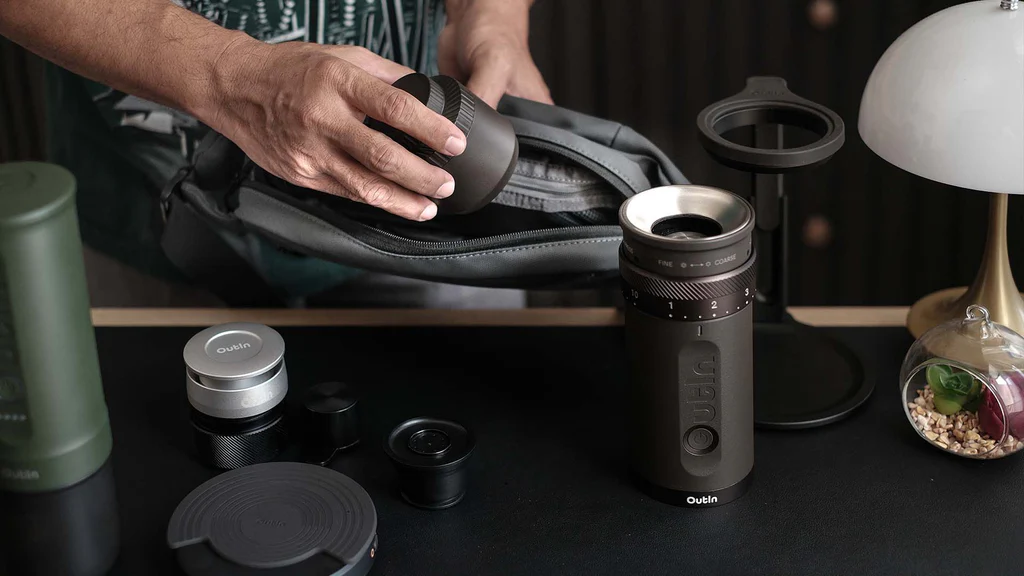
Electric self-heating portables like the OutIn Nano (670g / 1.48 lb) and CERA+ (1.6 lb) are heavier but eliminate the need for a separate kettle. It’s a classic size-versus-convenience trade-off, and the right answer depends entirely on your use case.
Espresso Quality and Crema Consistency
Espresso quality in portable devices is evaluated by crema thickness, extraction evenness, flavor complexity, and aftertaste. Consumer Reports’ 2026 evaluations of espresso machines — both home and portable — highlighted pressure consistency and crema stability as the two most reliable quality metrics across all price points.
The Picopresso earns a 4/5 espresso quality rating despite its tiny size, largely because it accepts up to 18g of ground coffee for a proper double espresso shot. The Nanopresso scores similarly and adds pod compatibility via an optional adapter. The Staresso, which supports milk-based drinks, consistently produces top-quality pours but sits heavier than most competitors.
Real espresso quality also depends heavily on your grind size. A fine, even grind — ideally from a burr grinder — makes a far bigger difference than the machine brand in many side-by-side comparisons.
The Best Portable Espresso Maker Options Compared Side by Side
Manual Hand-Pump Models
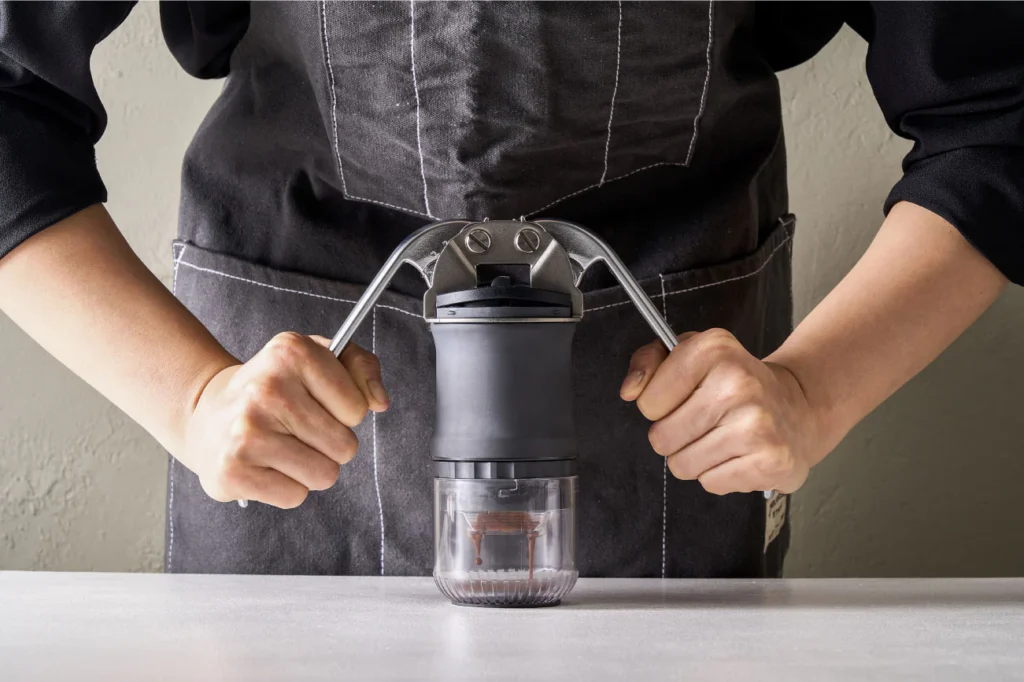
Manual portables are the lightest and most durable category. They use no batteries or electricity — just your own pumping motion to build pressure. The Wacaco Picopresso and Nanopresso dominate this space, and for good reason.
The Picopresso holds 18g of ground coffee, making it one of the only truly pocket-sized devices capable of a full double espresso. Its 2.76-inch diameter means it fits in a jacket pocket. The Nanopresso at 336g is slightly heavier but adds pod compatibility and has a slightly more forgiving learning curve for new users.
The Staresso is another manual worth mentioning — it’s the rare portable that can froth milk, making it viable for cappuccino-style drinks on the road. It’s heavier than both Wacaco models, but the versatility justifies the extra weight for travelers who want more than straight espresso shots.
Battery-Powered Electric Models
Battery-powered portables represent the fastest-growing segment of the market. The OutIn Nano Portable Electric is the benchmark here: it weighs 670g (1.48 lb), operates at 20-bar pressure, and self-heats 1.7oz of water from 77°F to 198°F in just 200 seconds using three included 2500mAh batteries. That self-heating capability is a genuine game-changer for travel.
The CERA+ steps up the battery game significantly: three 4500mAh batteries deliver up to 8 hot shots per charge, and it recharges via USB-C. At 1.6 lb it’s the heaviest portable on this list, but for all-day office use or multi-day travel without easy recharging access, that battery life is hard to beat.
Both electric models sacrifice some of the hands-on control that manual users love, but they win decisively on convenience and repeatability.
Capsule-Compatible and Hybrid Models
Several portables now accept both ground coffee and Nespresso-style capsules, broadening their appeal. The Nanopresso supports capsules via its Barista Kit adapter. This flexibility matters when you’re traveling and can’t guarantee access to freshly ground coffee — capsules are available in virtually every supermarket worldwide.
Pod compatibility does introduce trade-offs. Capsule espresso shots are generally less nuanced than properly extracted ground coffee, and the waste factor is real. But for travelers who prioritize consistency and convenience over artisanal quality, pod-compatible portables hit a practical sweet spot.
| Model | Weight | Pressure | Self-Heating | Max Coffee Dose | Price Range | Best For |
|---|---|---|---|---|---|---|
| Wacaco Picopresso | 0.79 lb (0.36 kg) | 18+ bar | No | 18g | $80–$90 | Ultralight travel, hiking |
| Wacaco Nanopresso | 0.74 lb (336g) | 18 bar | No | 8g (18g with kit) | $79.90 | Beginners, pod users |
| OutIn Nano Electric | 1.48 lb (670g) | 20 bar | Yes (200 sec) | — | $100–$120 | All-in-one travel |
| CERA+ Portable Electric | 1.6 lb | 20 bar | Yes | — | $120–$140 | Office, multi-day trips |
| Staresso | ~1.1 lb | 15–20 bar | No | Variable | $60–$80 | Milk drinks, versatility |
| Bialetti Moka Express | ~0.9 lb | ~1–2 bar | No (stovetop) | Variable | $54.99 | Camp stove, stovetop |
How to Use a Portable Espresso Maker Properly
Grinding and Dosing for Portable Devices
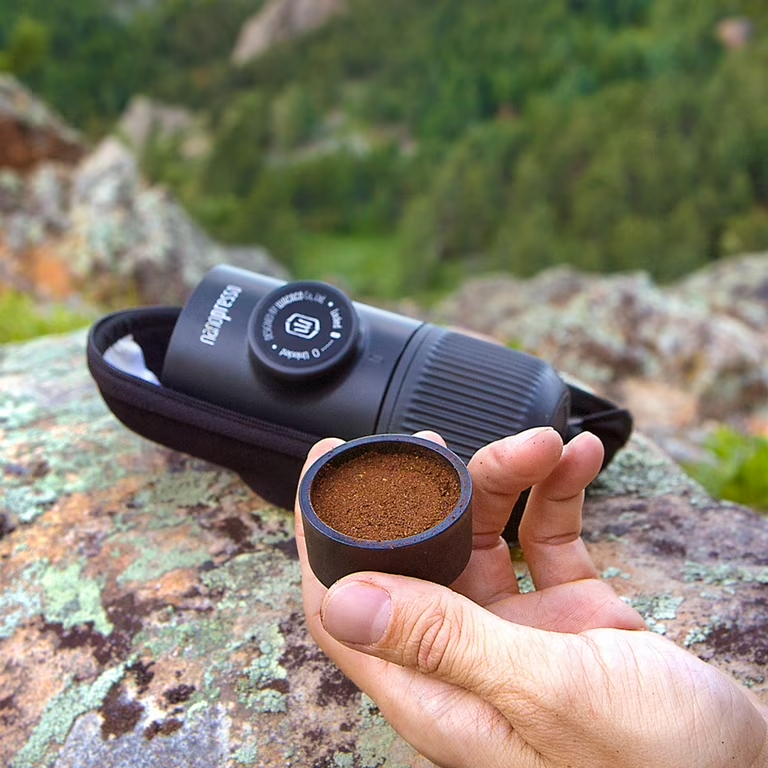
The single biggest mistake people make with a portable espresso maker is using pre-ground supermarket coffee. It’s usually ground too coarse for espresso extraction, resulting in weak, watery shots with no crema. You need espresso-fine ground coffee — think the texture of fine table salt, not coarse sea salt.
For the Picopresso specifically, dose 16–18g of finely ground coffee and tamp with moderate, even pressure. The 2.76-inch basket diameter means tamping technique is critical — uneven distribution causes channeling, where water finds the path of least resistance and produces under-extracted, sour espresso shots.
If you’re traveling without a grinder, pre-grind at home and store in small airtight containers. Some coffee shops will grind specifically for espresso if you ask nicely — just tell them it’s for a portable machine and you need it fine.
Water Temperature and Extraction Timing
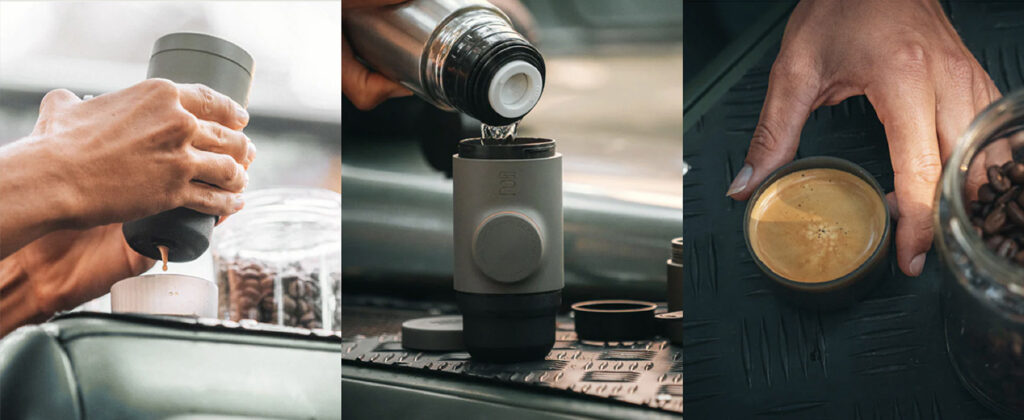
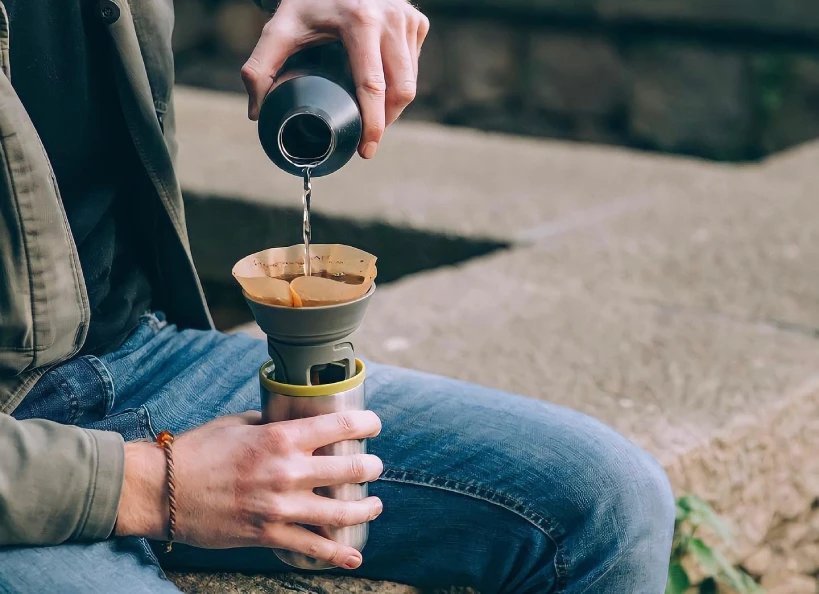
Espresso extracts best between 195°F and 205°F (90°C–96°C). For manual portables that require you to bring your own hot water, let freshly boiled water sit for 30–45 seconds before using. Pouring 212°F water directly onto your coffee puck risks over-extraction and bitter, harsh flavors.
The OutIn Nano takes care of this automatically — it heats water to 198°F, which sits right in the ideal window. This is one of the strongest arguments for electric portables: they remove a variable that even experienced baristas sometimes get wrong in field conditions.
Extraction time for a proper espresso shot should fall between 25 and 35 seconds for a standard 1–2oz yield. With manual portables, your pumping rhythm controls this. Slow, steady strokes — not fast aggressive pumps — produce better pressure consistency and more even extraction.
Step-by-Step Brewing Process
- Heat water to 195°F–205°F (or use an electric self-heating model).
- Grind coffee fine — espresso grind, 16–18g for a double shot.
- Fill the basket and tamp evenly with firm, level pressure.
- Fill the water chamber to the indicated level (typically 40–60ml for a double).
- Lock the components together securely.
- Begin extraction — pump slowly and steadily on manual models.
- Target 25–35 seconds of extraction time.
- Stop when you see the shot go pale or blonding begins.
- Enjoy immediately — espresso degrades fast.
Do Portable Espresso Makers Actually Make Real Espresso?
Defining “Real” Espresso
This is probably the most debated question in the portable coffee space, and it deserves a direct answer. Real espresso, as defined by the Istituto Nazionale Espresso Italiano, requires water at 88°C ± 2°C pushed through a compressed coffee puck at 9 bar ± 1 bar for 25 seconds ± 5 seconds, yielding 25ml ± 2.5ml of beverage.
By those metrics, yes — the best portable espresso maker options absolutely make real espresso. The Nanopresso’s 18 bar exceeds the minimum requirement. The Picopresso, used correctly, produces genuine crema-topped espresso that would pass a blind test against many home machines.
The honest caveat is that technique matters enormously with portables. A poorly tamped, under-heated, or unevenly ground shot from any device — portable or home machine — won’t taste like real espresso. The machine is only one variable in the equation.
Crema Quality and What It Tells You
Crema — the reddish-brown foam on a properly extracted espresso shot — is the most visible quality indicator. It forms when carbon dioxide dissolved in freshly roasted coffee emulsifies under high pressure extraction. You need two things to get it: fresh coffee (less than 4 weeks from roast date) and genuine espresso pressure above 9 bar.
Both the Picopresso and Nanopresso produce genuine crema when used with fresh, correctly ground coffee. Electric models at 20 bar also produce crema, often more consistently because the pressure is mechanically regulated rather than human-powered.
Thin, pale crema usually means stale coffee or too coarse a grind. Dark, spotty crema often means too fine a grind causing over-extraction. Use these visual cues to dial in your technique.
Comparing Portable vs. Home Espresso Machine Quality
A $2,000 home espresso machine with a PID temperature controller, pre-infusion, and precision pressure profiling will produce a technically superior shot to any portable device. That’s just honest. But the gap is smaller than most people assume — and in the right conditions, a well-dialed portable espresso maker comes remarkably close.
Consumer Reports’ 2026 evaluations tested espresso machines from $90 to $2,200 and found that crema consistency and pressure stability were the two metrics that most reliably predicted cup quality. The best portables score well on both when used correctly. You’re not replacing your home setup — but you’re not drinking inferior coffee either.
Which Portable Espresso Maker Is Best for Specific Use Cases?
Best for Hiking, Camping, and Backpacking
For weight-obsessed outdoor use, the Picopresso is the clear answer. At 0.79 lb with a sub-3-inch diameter, it adds almost nothing to a backpack. You’ll need a small camp stove or fire to heat water, but that’s standard camping kit anyway. The Picopresso’s all-plastic construction means it won’t crack in cold temperatures the way some older portables did.
Bring pre-ground coffee in a small airtight tin, a compact scale if you’re particular about dosing, and a small silicone tamp. That entire setup weighs under 2 lbs and fits in a fist-sized kit bag. For serious espresso drinkers doing multi-day backcountry trips, this is genuinely the best portable espresso maker configuration available.
The Bialetti Moka Express ($54.99) is a stovetop option that’s worth mentioning here — it makes strong, concentrated coffee over a camp stove. It’s not technically espresso (pressure only reaches 1–2 bar), but it’s durable, affordable, and makes delicious coffee if you’re not a strict espresso purist.
Best for Business Travel and Hotel Use
Business travelers have different priorities: minimal setup time, no mess, and consistent results without needing to think too hard at 6 AM in a foreign hotel room. The OutIn Nano or CERA+ electric models win here decisively.
The OutIn Nano’s 200-second heat time means your espresso is ready in about three minutes from cold start. The CERA+’s USB-C charging means you’re not hunting for proprietary cables. Both produce repeatable 20-bar shots without requiring kettle management or precise water temperature monitoring.
For hotel rooms with nothing but a standard outlet, a portable electric espresso maker eliminates dependence on the lobby coffee machine or the questionable instant packets on the desk. That alone makes the investment worthwhile for regular business travelers.
Best for Office Use
Office use favors the CERA+. Its eight shots per charge means you can get through a full workday without recharging. USB-C charging from a laptop or desktop USB port is genuinely convenient. It’s heavier than the OutIn Nano, but you’re not hiking with it — it sits on your desk.
An important consideration for office portables: noise. Manual portables are nearly silent. Electric pump models produce a noticeable buzzing hum during extraction. In open-plan offices, this can draw attention. Check your office culture before committing to an electric model.
Common Mistakes to Avoid With a Portable Espresso Maker
Grind and Tamp Errors
Using pre-ground coffee meant for drip machines is the number one mistake. Drip grind is too coarse for espresso extraction — water passes through too quickly, giving you weak, under-extracted shots with minimal crema. Always use espresso-specific grind settings.
Uneven tamping is the second most common error. In the small baskets of portable machines (the Picopresso’s basket is tiny), even a slightly tilted tamp creates channels. Practice tamping on the kitchen counter at home before you rely on your portable maker in the field. Consistency in tamping pressure matters more than the exact pressure amount.
Over-dosing — packing too much coffee — creates another common failure mode. The basket has a maximum fill level for a reason. Overfilling prevents proper tamping and causes the puck to crack during extraction, leading to channeling and uneven extraction.
Water Quality and Temperature Mistakes
Hard water is the enemy of portable espresso makers. Mineral buildup (scale) clogs the narrow internal passages in portables faster than in home machines because the water volume is smaller and the passages are tighter. If your tap water is hard, use filtered or bottled water. Your machine will last significantly longer and your espresso will taste better.
Temperature errors are equally common. Too hot (above 205°F) scorches the coffee, producing bitter, harsh flavors. Too cool (below 190°F) under-extracts, giving you sour, weak shots. For manual portables, the 30–45 second resting period after boiling is your simplest temperature management tool.
Cleaning and Maintenance Neglect
Portable espresso makers are small, which means old coffee oils accumulate in proportionally larger concentrations relative to the water volume. A machine that isn’t rinsed after every use develops rancid oil buildup that taints subsequent shots with stale, bitter flavors.
The basic cleaning routine is simple: disassemble, rinse all parts with hot water, and allow to air dry completely before storing. Full deep-cleaning with a dedicated espresso cleaner like Cafiza should happen monthly for regular users. The Home Barista community forum has detailed cleaning threads for every major portable model if you want device-specific guidance.
Portable Espresso Maker Buying Guide: What to Look for Before You Purchase
Budget and Value Assessment
The best portable espresso maker for most people sits in the $80–$120 range. Below $60, you’re generally looking at devices that can’t sustain adequate pressure, use flimsy materials, or produce inconsistent espresso quality. Above $140, you’re paying for premium battery capacity or brand prestige rather than meaningfully better espresso.
The Nanopresso at $79.90 remains one of the best value propositions in the category — 18 bar pressure, pod compatibility, proven durability over years of production. The Picopresso at $80–$90 offers better espresso quality and lower weight for slightly more money. For most first-time buyers, either Wacaco model is the right starting point.
Electric models command a premium for the self-heating convenience. The OutIn Nano and CERA+ are genuinely worth the extra $30–$40 over manual models if you regularly travel without reliable kettle access or if setup simplicity is a top priority.
Material Quality and Durability
Portables take more physical abuse than home machines — they get packed, unpacked, dropped, and exposed to temperature extremes. Look for food-safe materials, robust locking mechanisms, and replaceable o-rings. Wacaco’s portables use high-quality polypropylene that handles temperature shock well and doesn’t impart flavors.
Avoid ultra-cheap portables with thin plastic threads on the water chamber — those strip after a few weeks of regular use. Aluminum components, while heavier, are more durable for the filter basket and filter cap. Check that replacement parts (gaskets, baskets, screens) are readily available before purchasing any device.
Accessory Ecosystem and Support
A strong accessory ecosystem extends the value and lifespan of your portable espresso maker significantly. Wacaco offers a full range of accessories for both the Picopresso and Nanopresso: protective cases, NS Adapter kits for Nespresso pods, Barista Kit extensions, and replacement seals. CERA+ and OutIn Nano have growing accessory ranges but don’t match Wacaco’s depth yet.
Customer support responsiveness matters too. Portable machines have small moving parts and seals that wear out. A brand that sends replacement o-rings quickly and has active community forums saves you from buying a whole new device every 18 months. Wacaco’s support reputation is strong by community consensus as of 2026.
The History and Evolution of Portable Espresso Makers
From Stovetop Moka to Modern Portables
The Bialetti Moka Express, introduced in 1933, was the first widely accessible portable espresso-adjacent device. It doesn’t make true espresso — its stovetop steam pressure tops out around 1–2 bar — but it democratized strong concentrated coffee for home and travel use. At $54.99 today, it remains relevant, particularly for camping where a heat source is already available.
The first genuinely pressure-capable portable espresso makers emerged in the 2010s, led by devices like the Handpresso and early Wacaco models. These proved that it was mechanically possible to generate real espresso pressure through human-powered pumping mechanisms in a hand-held device. The espresso quality wasn’t always there, but the proof of concept held.
The 2020s brought electric miniaturization. Battery technology advances enabled devices like the OutIn Nano to pack genuine heating elements and electric pumps into sub-700g form factors. The best portable espresso maker of 2026 produces shots that would have been unimaginable from a battery-powered device just five years ago.
Where the Category Is Heading
The trajectory of portable espresso in 2026 points toward smarter electric devices with app connectivity, pressure profiling capabilities, and longer battery life. Several prototype devices demonstrated at 2025 specialty coffee trade shows incorporated Bluetooth-enabled pressure control — letting users adjust extraction curves from a smartphone.
Weight will continue to decrease as battery energy density improves. The current 670g benchmark for electric portables could realistically fall below 400g within a product generation or two. Sustainability is also a growing factor — reusable pod systems and biodegradable filter designs are appearing in new releases.
Manual portables aren’t going anywhere. Their simplicity, durability, and zero-battery-needed operation keep them relevant for outdoor use cases where electronics are a liability. The Picopresso’s 5/5 portability and value scores reflect a design that’s essentially already optimal for its category.
Frequently Asked Questions
What is the best portable espresso maker for travel?
The best portable espresso maker for most travelers is the Wacaco Picopresso (lightweight manual) or the OutIn Nano (electric, self-heating). The Picopresso weighs just 0.79 lb and produces genuine espresso quality. The OutIn Nano heats its own water in 200 seconds, making it ideal when kettle access isn’t guaranteed. Your choice depends on whether you prioritize weight or convenience.
Are portable espresso makers worth it?
Yes — if espresso quality matters to you and you travel or commute regularly. Devices like the Nanopresso at $79.90 produce genuine 18-bar espresso shots comparable to entry-level home machines. Over a year of daily travel use, that investment easily offsets the cost of buying café espresso. The learning curve is real but short — most users dial in their technique within a week.
How do you use a portable espresso maker?
Heat water to 195°F–205°F, grind coffee to espresso fineness, dose 16–18g into the basket, tamp evenly, fill the water chamber, lock the device, and extract slowly for 25–35 seconds. Electric self-heating models simplify this by managing water temperature automatically. Consistent grind quality and even tamping are the two variables that most affect shot quality.
What is the difference between the Wacaco Picopresso and OutIn Nano?
The Picopresso is manual, weighing 0.79 lb, and requires pre-heated water — ideal for ultralight travel. The OutIn Nano is electric at 1.48 lb, self-heats water to 198°F in 200 seconds, and runs on three 2500mAh batteries. The Picopresso offers more hands-on control; the OutIn Nano offers plug-and-play convenience. Both produce genuine espresso at comparable quality levels.
Do portable espresso makers actually make real espresso?
Yes, the best ones do. Real espresso requires at least 9 bars of pressure — the Nanopresso delivers 18 bar, and electric models hit 20 bar. When used with fresh, finely ground coffee at proper extraction temperature, portable machines produce crema-topped espresso indistinguishable from many home machines in blind taste tests. Technique and coffee freshness matter as much as the device itself.
Which portable espresso maker has a built-in pump?
The OutIn Nano and CERA+ both feature built-in electric pumps that automatically regulate pressure at 20 bar. Manual portables like the Picopresso and Nanopresso use hand-operated piston pumps that you power yourself. Electric pump models offer more pressure consistency and easier operation; manual pump models are lighter, simpler, and require no battery power.
How do you clean a portable espresso maker?
After every use, disassemble the device and rinse all components with hot water — no soap needed daily, as soap residue affects flavor. Air dry completely before storage to prevent mold. Monthly, deep-clean with food-safe espresso cleaner like Cafiza. Inspect and replace o-ring seals every 6–12 months. Hard water users should descale quarterly using a diluted citric acid solution.
What is the best portable espresso maker for beginners in 2026?
For beginners, we recommend starting with an entry-level portable maker machine that includes PID temperature control and a standard 58mm portafilter. These two features provide enough control to learn proper extraction technique without overwhelming you with variables you cannot yet appreciate. Budget $300-500 for the machine and $150-250 for a quality burr grinder — the grinder investment is just as important as the machine at this stage.
How long do portable maker espresso machines typically last with regular use?
With proper maintenance including regular backflushing, descaling every 2-3 months, and annual gasket replacement, a quality portable maker machine should last 8-15 years of daily home use. Higher-end models with commercial-grade components like E61 group heads, brass boilers, and rotary pumps routinely last 20+ years. The most common failure points are scale buildup in the boiler, worn group gaskets, and pump motor fatigue — all of which are preventable with routine care or repairable for a fraction of the replacement cost.
Is it worth upgrading from a portable maker entry model to a mid-range machine?
The upgrade is worth it only after you have maxed out what your current machine can do and you can consistently identify what is holding you back. If your main frustrations are slow steaming transitions, temperature instability between shots, or inability to steam and brew simultaneously, a mid-range dual boiler will solve those specific problems. However, if your shots are inconsistent due to grind quality or technique, upgrading the machine will not help — invest in a better grinder first, as grind quality accounts for roughly 60 percent of shot quality.
Who Should Buy a Portable Maker Machine — And Who Should Look Elsewhere
The Beginner (Budget: Under $500)
If you are new to espresso and want to learn proper technique without a massive upfront investment, an entry-level portable maker machine is a solid starting point. Look for models with PID temperature control and a standard-size portafilter — these two features give you enough control to develop real skill while being forgiving of common beginner mistakes like inconsistent tamping pressure or slightly off grind settings. Expect a learning curve of 2-4 weeks before you are consistently pulling good shots. You will also need to budget $150-250 for a capable burr grinder — the grinder matters as much as the machine at every price tier. If you want push-button convenience with absolutely no learning curve, a super-automatic or Nespresso system will serve you better, and there is no shame in that choice.
The Daily Enthusiast (Budget: $500-1500)
You have been making espresso at home for at least six months. You own a dedicated burr grinder, you understand dose-yield-time relationships, and you are ready for better temperature stability, faster milk steaming, and finer control over your extractions. Mid-range portable maker machines deliver a genuine and noticeable step up in build quality, thermal stability, and shot consistency that you will taste immediately. This tier is ideal for daily home baristas who pull 2-5 drinks per day and care about both straight espresso and milk-based drinks. If you primarily make milk drinks for the family each morning, a dual-boiler model at this tier saves significant time compared to a single-boiler machine where you have to wait between brewing and steaming. You should already understand extraction concepts at this level — otherwise you are paying for capabilities you cannot yet leverage.
The Prosumer (Budget: $1500+)
You have refined your palate to where you can taste the difference between 93 and 95 degree extraction temperatures. You own a high-end flat or conical burr grinder, and you want commercial-caliber results without leaving your kitchen. Premium portable maker machines offer dual boilers, pressure or flow profiling, rotary pump options, and build quality that will last 15-20 years with proper care. This tier makes financial sense only if you have already mastered fundamentals on a simpler machine and genuinely need the additional control for experimentation — pressure profiling, temperature surfing, and ultra-precise flow rates. If you entertain frequently, run a small office coffee program, or simply refuse to compromise on shot quality after years of progression through the hobby, this is your destination. Just be prepared for a significant countertop footprint (most E61 machines need 14-16 inches wide by 18-20 inches deep), a 20-40 minute warm-up time, and a grinder investment that matches the machine’s capability.
Final Thoughts
The best portable espresso maker is the one that fits your specific use case — not necessarily the most expensive or the most featured. For ultralight outdoor use, the Wacaco Picopresso at 0.79 lb and 4/5 espresso quality is hard to beat. For all-in-one travel convenience, the OutIn Nano’s 200-second self-heating and 20-bar pressure make it the most friction-free option. For office warriors who want all-day battery life, the CERA+ with 8 shots per USB-C charge is the practical winner.
The market has matured significantly. A best portable espresso maker purchased in 2026 genuinely produces real espresso — not a weak approximation, but shots with crema, complexity, and the caffeine hit you need. The key is investing in fresh, properly ground coffee and spending fifteen minutes learning the tamping and extraction basics. The device is the easy part.
Every best portable espresso maker on this list represents a category that barely existed a decade ago and now delivers experiences that rival home setups costing ten times more. Whether you choose manual or electric, Wacaco or OutIn, the best portable espresso maker you’ll ever own is the one that gets you a great shot wherever you happen to be standing. Start with one of the models in this guide, and you won’t be disappointed.