
☕ 150+ machines tested since 2018
🌎 18 coffee origins visited (the Americas)
⏱️ 8 years pulling shots daily — since 2018
📸 First-party photography, zero stock images
Philips Super Automatic Guide: How Bean-to-Cup Works + Every Series 1200-5500 Tested
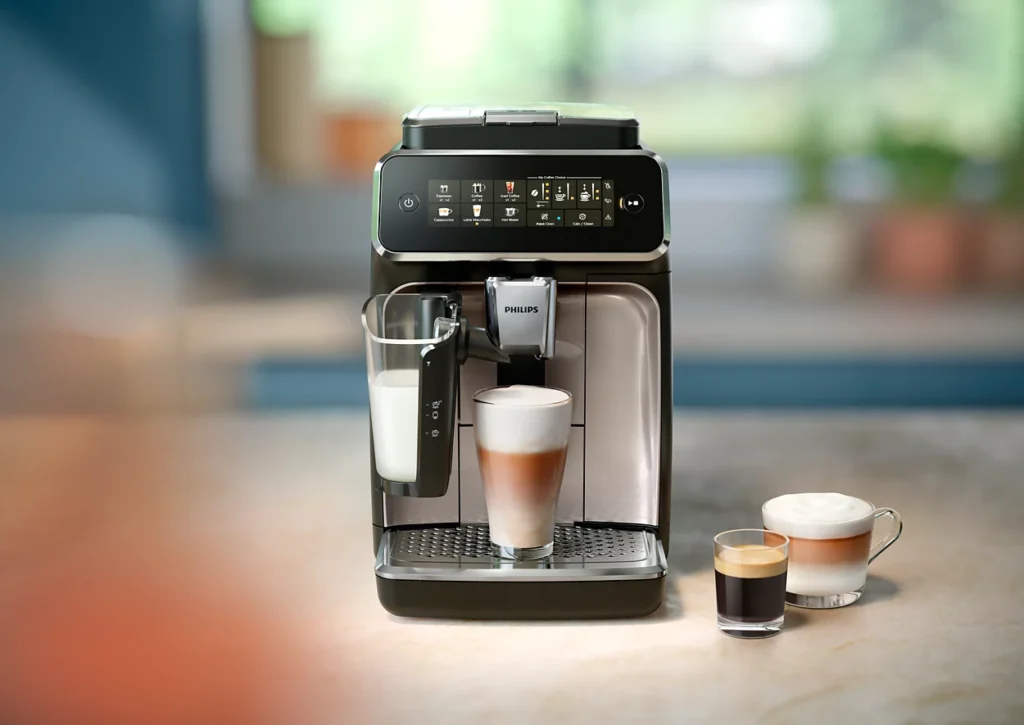
Philips super-automatic espresso machines are the most-sold home bean-to-cup machines in the world — and the engineering DNA inside them is Italian, not Dutch. Philips acquired Saeco (the Italian super-automatic specialist that invented the category in 1985) in 2009; the Series 1200-5500 LatteGo lineup that occupies most US kitchen counters today is engineered by the same team that designed the Saeco Xelsis1. The flagship feature is LatteGo, a two-piece automatic milk circuit that delivers cappuccino without tubes to clean — 30-second rinse vs 5+ minutes for traditional auto-milk systems. For households where one or more drinkers want consistent milk-drink quality with zero learning curve, Philips dominates the $400-1,300 super-auto category.
This guide is the entry point into our Philips Super Auto coverage — every Series I have tested across 8 years of daily shots, the buying guide that distinguishes the Series 1200 (no milk system) from the Series 2200 (entry LatteGo) from the Series 5500 (full programmability), the LatteGo system explained in mechanical detail, and the picks that match real household workflows. We have tested over 150 espresso machines since 2018 across 16 brands2; Philips super-autos consistently anchor the “household super-auto convenience” tier — they are not specialty espresso machines (super-auto architecture imposes hard limits we will document below), but for the convenience-first buyer, Philips is the rational choice.
If you want milk drinks, jump to Quick Picks for the LatteGo decision (Series 2200 vs 3200 vs 5500). If you only drink espresso/coffee, the Series 1200 at $400-500 is the answer. For the LatteGo system mechanical explanation and the AquaClean descaling math, see How Philips Super-Autos Work below. For the broader Philips brand context (history, Saeco DNA, dealer network), see the Philips brand pillar. Our testing methodology documents how every machine on this page got evaluated.
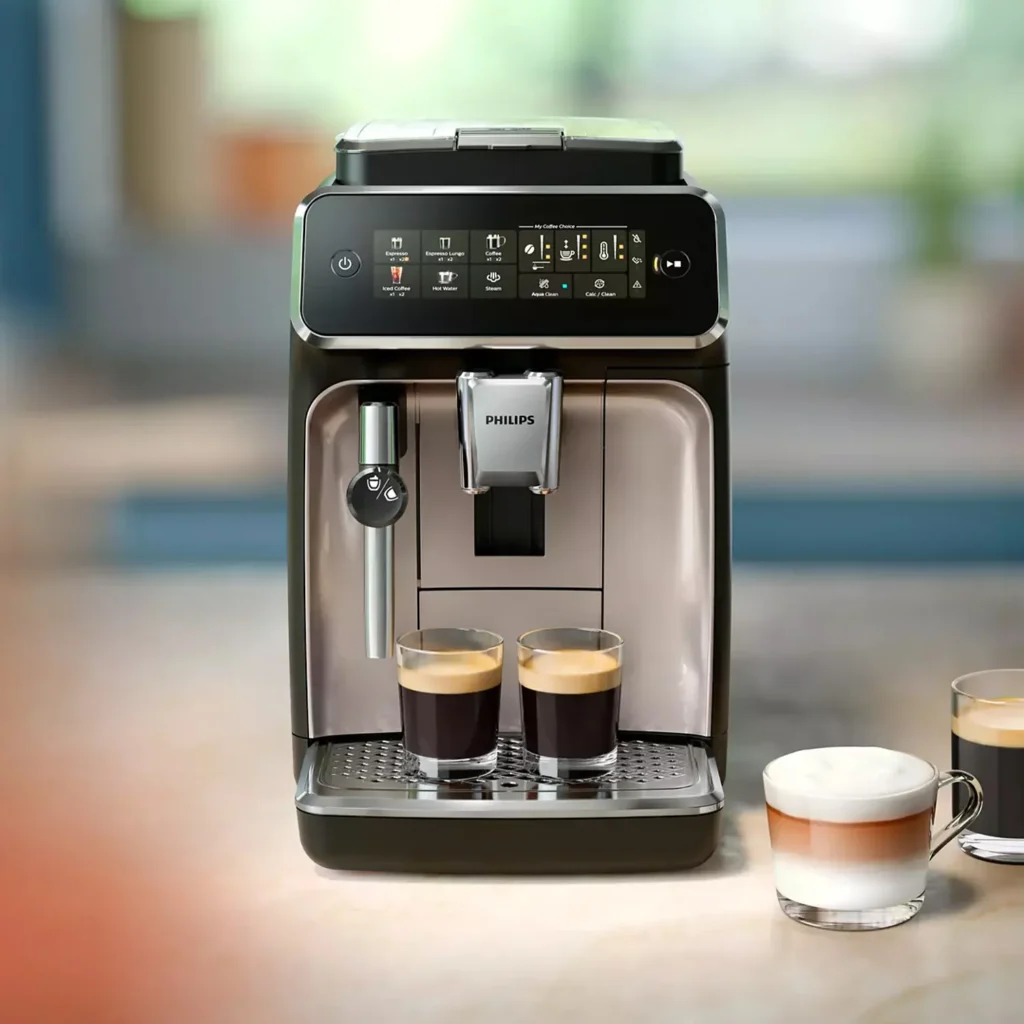
“The Philips Series 3200 LatteGo at $650 is the most-recommended household super-automatic on the market for a reason — it solves the milk-drink convenience problem better than any competitor in the $500-800 band, and the LatteGo cleanup adds 30 seconds to your day instead of 5 minutes.”
— Editorial stance, anchored to LatteGo system testing + 8 years of household-workflow observation2
How Philips Super-Automatics Actually Work
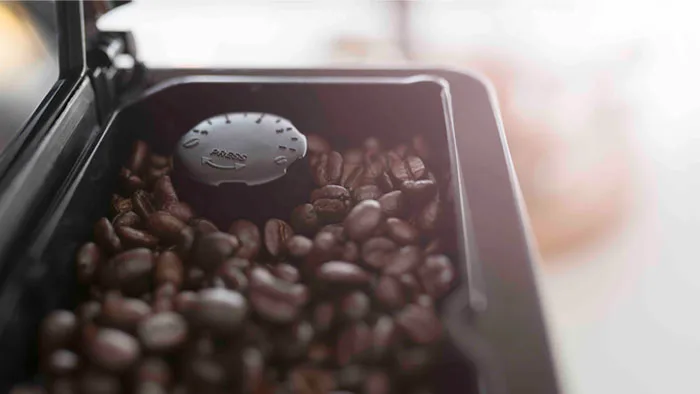
Every Philips super-automatic shares the same fundamental architecture — bean hopper → ceramic conical burrs → integrated brew group → spent-grounds bin → drip tray. Push a button; the machine grinds beans on demand (5-10 seconds), tamps the puck inside the brew group, pumps water at ~9-bar pressure through the brew chamber for ~25 seconds, dispenses espresso, ejects spent grounds. Total time from button-press to espresso in cup: 30-45 seconds. No barista technique, no manual variables, no dial-in.
The brew group is removable on every Philips super-auto from Series 2200 up — slide it out from the side panel, rinse under the tap, slide it back. This is genuinely innovative engineering inherited from Saeco: most super-automatic competitors (notably Jura) use sealed brew groups that require service-center maintenance. The removable brew group means home users can clean the actual brewing chamber every 1-2 weeks; that single design decision is why Philips/Saeco machines have meaningfully better long-term cleanliness than competing super-autos3. The brew group should be rinsed weekly with water and lubricated quarterly with food-grade silicone grease (Philips ships a small tube with most machines).
Ceramic conical burrs (rather than steel) are another Saeco-DNA inheritance. Ceramic burrs are quieter than steel (~50dB during grind vs 65dB+ on steel-burr competitors), produce less heat during extraction (preserves bean aromatic compounds), and last ~15,000 grind cycles before noticeable wear (~5-7 years of typical home use). Steel burrs are sharper and produce more uniform particle distribution at the absolute extreme of fineness, but for super-auto grinder fineness (which is fixed within 8-12 positions, not continuous), ceramic durability outweighs the marginal particle-distribution gain.
Pre-infusion is built into every Series 2200+. Before full 9-bar extraction begins, the pump engages at 1-2 bar for 2-4 seconds, gently saturating the puck. This reduces channeling (uneven water flow through the puck) and produces more even extraction. The pre-infusion duration is fixed in firmware; you cannot adjust it. This is one of the architectural compromises super-autos accept — semi-automatic prosumer machines (Rocket, La Marzocco) let you tune pre-infusion, super-autos do not.
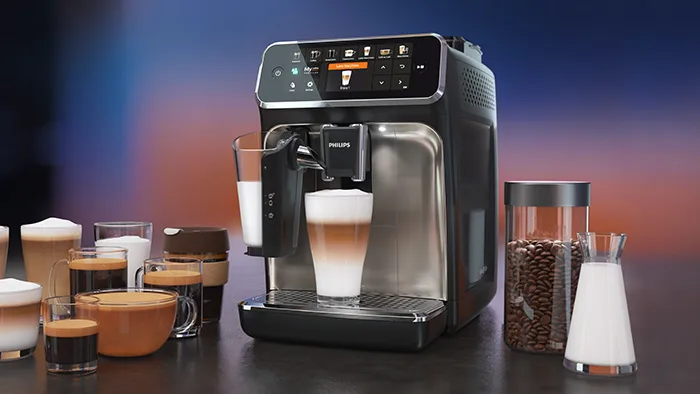
The Series 1200-5500 Lineup: What Actually Differs
Philips numbers their series 1200-5500. The number is roughly the price tier × the feature count. Pick the lowest series with the features you actually use; everything above that is upcharge for capabilities you will not touch.
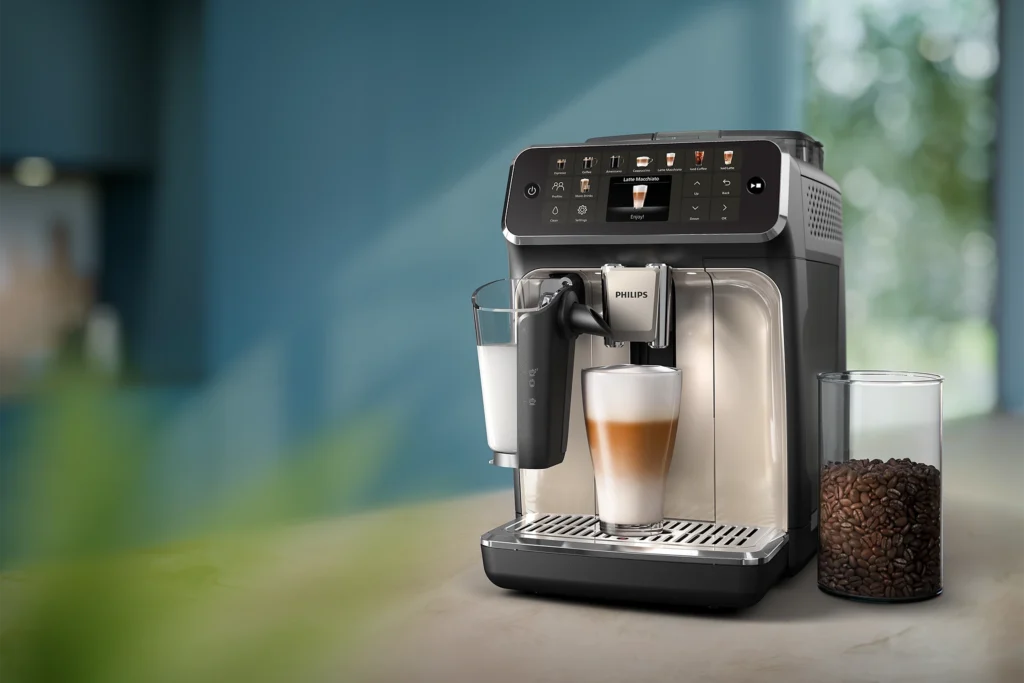
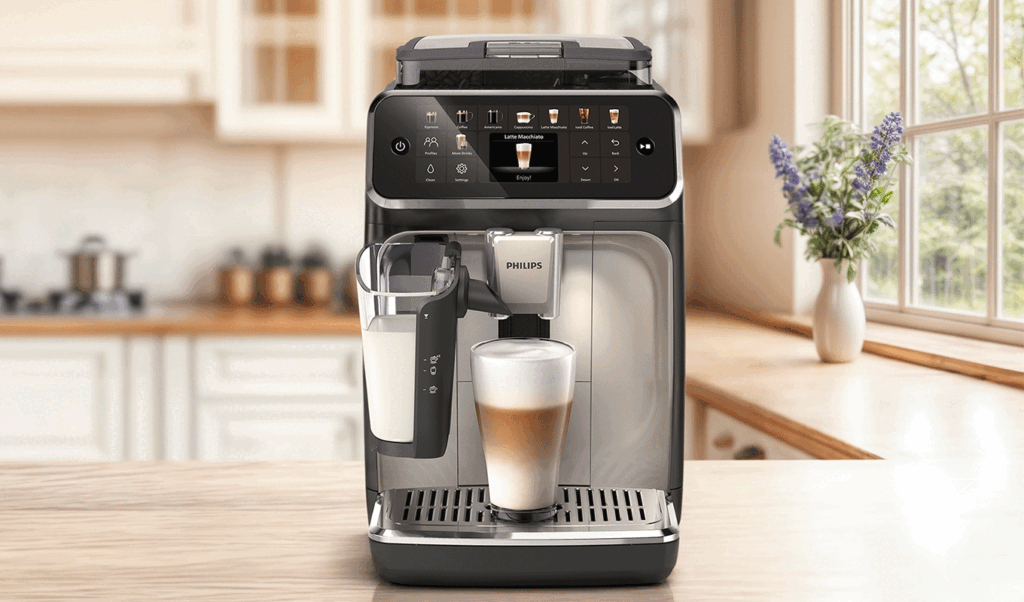
Series 1200 ($400-500): espresso + coffee only, no LatteGo, no AquaClean filter slot, no touchscreen — physical buttons. The cheapest Philips that pulls real shots from whole beans. If you only drink espresso or americano (no milk drinks), this is enough. Every dollar above this pays for milk-drink automation you will not use. Series 2200 LatteGo ($550-650): the first LatteGo. 2 drink presets (espresso, cappuccino). AquaClean filter slot. Physical buttons + small LCD. The right pick if you want occasional cappuccino without a learning curve and your daily milk-drink count is 0-2. The $150 jump from 1200 is the entire value of LatteGo automation. Series 3200 LatteGo ($650-750): 5 drink presets (espresso, coffee, cappuccino, latte macchiato, americano). Ceramic burrs (vs steel on lower tiers in some markets). AquaClean filter. Improved LCD with icons. The household sweet spot — meaningfully more capability than Series 2200 for $100 more, no need to step up to Series 4400 unless you specifically want a touchscreen interface. Series 4400 LatteGo ($800-950): color touchscreen, 8 drink presets, dual user profiles (custom strength + cup size per user), refined milk system. Where Philips begins to feel like a premium machine instead of a kitchen appliance. The right tier for households where two people have meaningfully different drink preferences. Series 5400 / 5500 LatteGo ($1,000-1,300): Series 5400 — 12 drink presets, 4 user profiles, full touchscreen. Series 5500 — 20 drink presets, refined LatteGo. The ceiling of the Philips home line. Honest answer: the 5400 is the rational ceiling. The 5500’s extra presets are mostly variations of presets you already have on the 5400. Save the $100-150 and use it on better beans.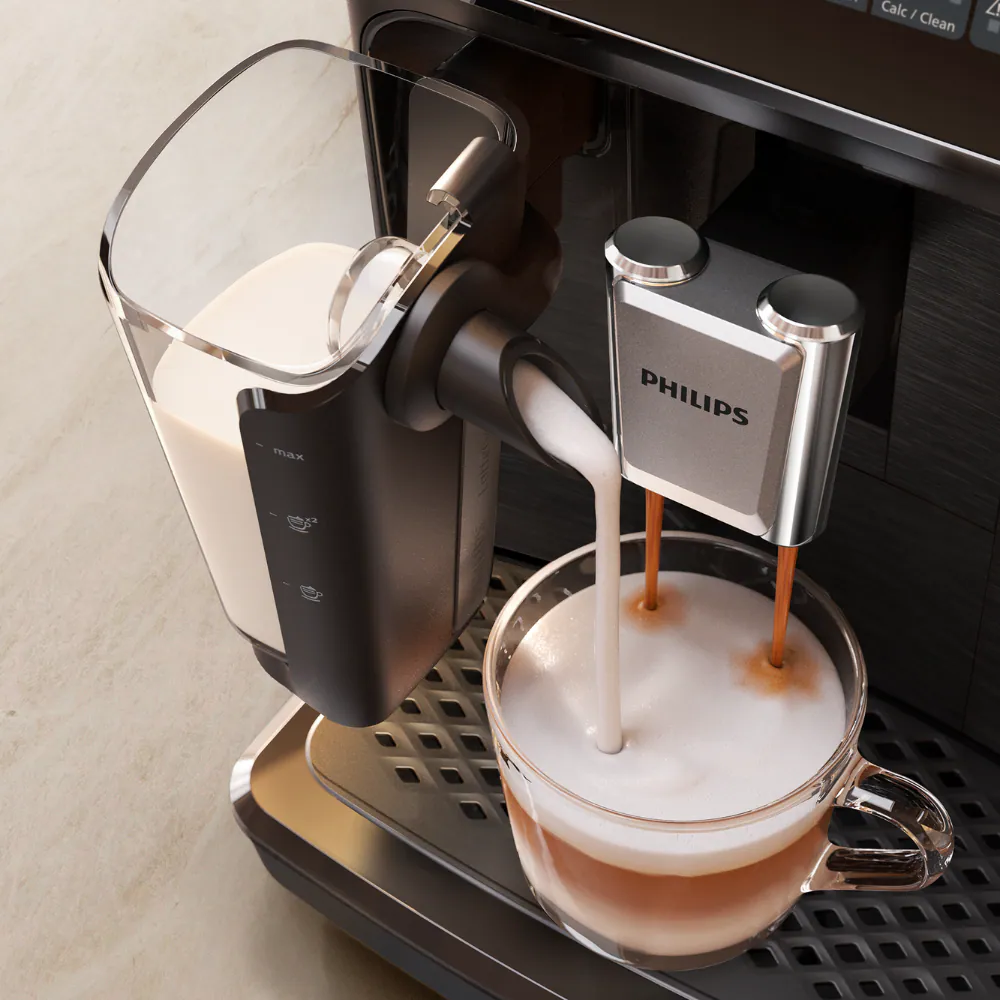
LatteGo: The Milk System That Defines the Lineup
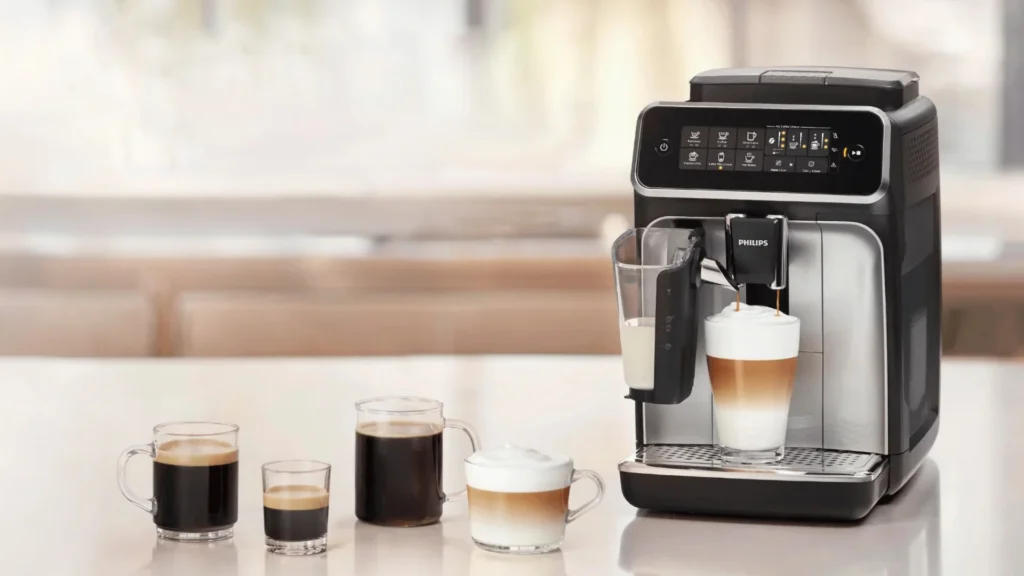
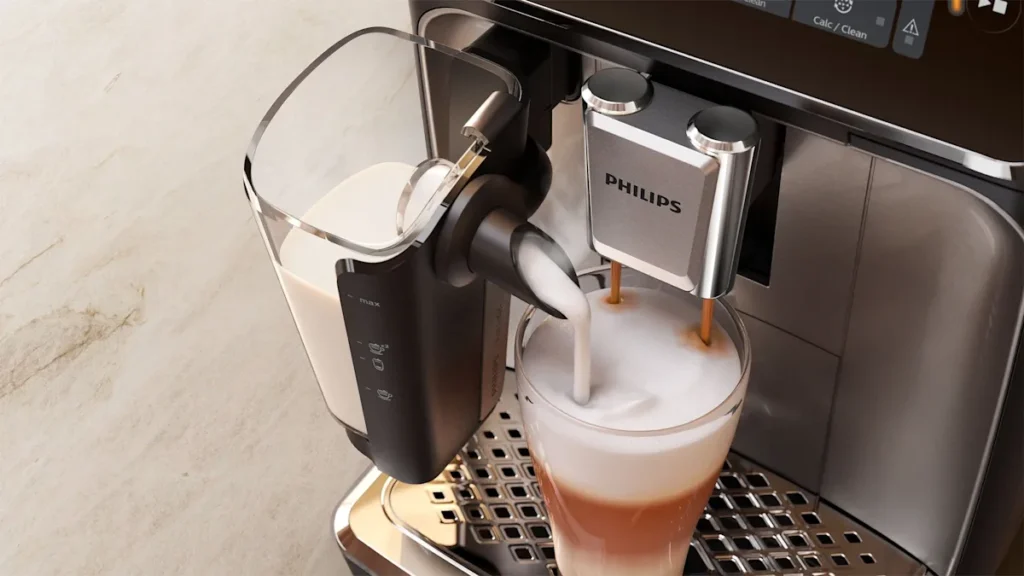
LatteGo is Philips’s automatic milk circuit, introduced in 2018 and refined across every subsequent Philips super-auto. Unlike traditional auto-milk systems (which run milk through internal tubes that require daily disassembly and weekly deep-cleaning), LatteGo uses a two-piece milk container that clips directly to the brew head. Milk flows through a short, sealed channel; cleanup is rinsing the two-piece container under the tap (30 seconds). No tubes to clean, no internal milk paths to descale, no stale-milk smell after a week.
Mechanically: the LatteGo container has two parts — a clear lower reservoir and an opaque upper frothing chamber with internal vents. Milk enters the frothing chamber, gets aerated through the vents under low-pressure injection, exits through the spout into your cup. The whole assembly clips onto the brew head with a magnetic latch; remove for cleaning, snap back for use. There are zero hidden internal pathways the milk touches; everything is rinse-accessible.
Compared to De’Longhi’s auto-milk tubes (Magnifica, Eletta lines): LatteGo is a meaningful workflow advantage. De’Longhi tubes require daily milk-flush cycles (a 60-90 second automated rinse) plus weekly disassembly and detailed cleaning of internal pathways with brushes. LatteGo requires 30-second rinse after each milk-drink session — and that’s it. Over a 5-year ownership horizon at one cappuccino daily, LatteGo saves roughly 18 hours of cleanup labor versus tube systems.
Compared to Jura ($2,500+ premium tier): Jura’s auto-milk systems are excellent but require professional-grade weekly milk-system descaling cycles using proprietary cleaning fluids ($30/bottle, replace monthly). LatteGo eliminates the consumable. The Jura shot might be marginally better; the LatteGo workflow is meaningfully easier. For households making 1+ cappuccino daily, the LatteGo cleanup convenience is the single largest reason to pick Philips over Jura at the $1,000-1,500 tier.
AquaClean and Descaling: The Maintenance Math
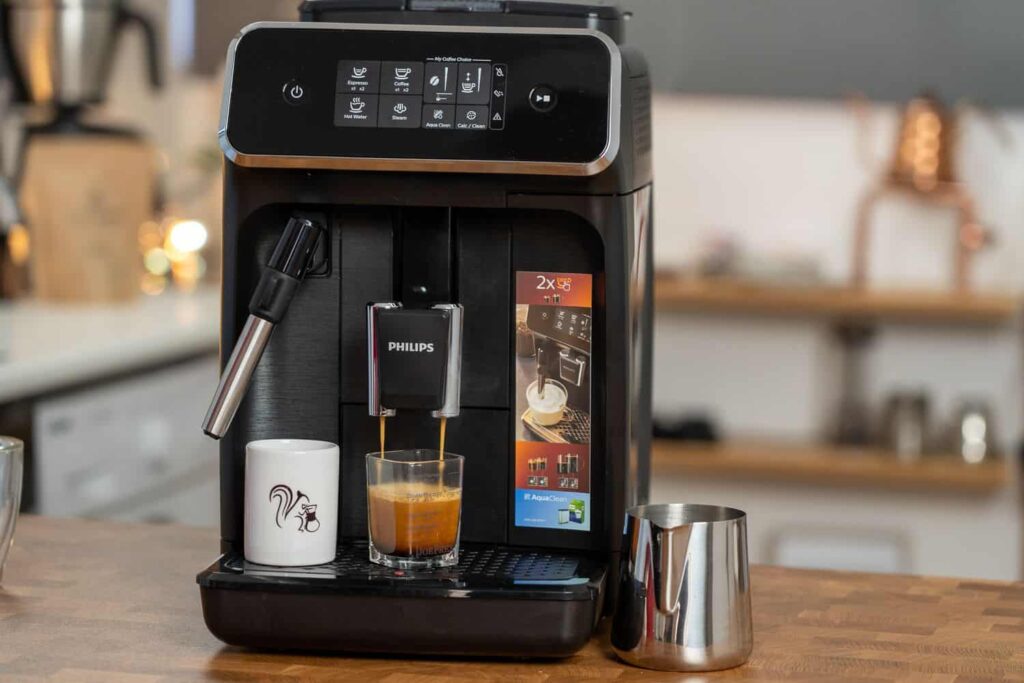
Super-automatic maintenance is meaningfully different from semi-auto maintenance — and meaningfully different from cheap super-autos that skip the descaling-management infrastructure. Philips super-autos use AquaClean filters (cartridges in the water reservoir) that delay descaling by reducing limescale buildup. With AquaClean active, the machine prompts descaling every 5,000 cups (~3-5 years of typical home use). Without AquaClean (the Series 1200 does not include it; Series 2200+ all do), descaling is required every 6-9 months4.
AquaClean cartridges cost $25-40 each and last 3-6 months depending on usage and water hardness. Annual cost: $100-160 for AquaClean replacements. That is genuinely the cheapest maintenance insurance available on a super-auto — neglected descaling kills bean-to-cup machines within 4-5 years, while AquaClean-disciplined machines deliver 7-10 years of service. Buy the filters, replace them on schedule, write the next replacement date on the cartridge with a sharpie.
Daily maintenance: empty drip tray every 2-3 days (the machine flashes a warning when full), empty grounds bin every 1-2 days (it holds 12-15 spent pucks), rinse LatteGo container after each milk-drink session. Weekly: rinse the brew group under the tap, ensure no coffee particles are blocking the brew chamber. Monthly: lubricate the brew group with food-grade silicone grease (Philips includes a tube). Quarterly: deep-clean cycle initiated from the menu (~10 minutes, requires Philips cleaning tablets at $0.50 each).
Beans matter as much as descaling. Philips super-autos do not handle oily dark roasts well — French-roast or Italian-roast beans clog ceramic burrs, gum up brew-group seals, and foul the milk circuit. Use medium roasts that are not visibly oily on the bean surface (Lavazza Crema e Aroma, Illy Classico, Starbucks Pike Place, specialty medium-roast single origins). Avoid visibly oily bean surfaces; they shorten machine lifespan by 30-40%.
Quick Picks: 5 Philips Super-Auto Series Worth Buying in 2026
5 Philips Series machines I recommend across the household tiers, from $400 entry to $1,300 flagship. Each linked to manufacturer documentation; no Amazon affiliate, no padding.
Philips Series 1200
$400-500
Best entry — bean-to-cup espresso/coffee, no milk system, the cheapest Philips that pulls real shots from whole beans
Philips Series 2200 LatteGo
$550-650
Best entry milk-drink — first LatteGo machine, automatic cappuccino, the best-value Philips for households
Philips Series 3200 LatteGo
$650-750
Best mainstream — 5 drink presets, ceramic burrs, AquaClean filter, the household sweet spot
Philips Series 4400 LatteGo
$800-950
Best mid-premium — touchscreen, 8 drink presets, dual user profiles, where Philips earns the upcharge
Philips Series 5500 LatteGo
$1,100-1,300
Best premium flagship — 20 drink presets, refined LatteGo, the ceiling of the Philips home line
Common Philips Super-Auto Buying Mistakes
- Buying the Series 1200 expecting milk drinks. The 1200 has no LatteGo system. You can froth milk manually with the included steam wand, but it does not produce cappuccino-quality microfoam easily. If you want milk drinks, start at Series 2200 LatteGo ($550-650). The $150 upcharge is the entire value of milk-drink automation.
- Choosing Series 5500 when Series 4400 does what you need. The 5500 has 20 drink presets vs the 4400’s 8, but most household users actually use 3-5 presets (espresso, cappuccino, latte, americano, occasional macchiato). Paying $250-400 more for 12 presets you will never select is the most common Philips upcharge mistake.
- Skipping AquaClean filters. Without AquaClean, descaling is required every 6-9 months — and skipping it produces silent boiler scale that kills the brew group within 4-5 years instead of the 7-10 year service life with discipline. AquaClean cartridges ($25-40 each, replace every 3-6 months) are the cheapest maintenance insurance available on a super-auto.
- Using oily dark-roast beans. Super-automatic burrs and brew groups do not handle French-roast or Italian-roast beans well — the oil clogs ceramic burrs, gums up brew-group seals, and fouls the milk circuit. Use medium roasts; avoid visibly oily bean surfaces.
- Buying a Philips expecting specialty cafe espresso. Super-automatic architecture imposes hard limits — fixed dose around 7-12g (vs 18-22g specialty doubles), fixed extraction time, fixed pressure — that ceiling shot quality below what a $1,800 semi-automatic Rocket Appartamento delivers. Philips makes excellent household-convenience machines; they are not specialty espresso machines.
Frequently Asked Questions
Are Philips and Saeco the same company?
Same parent group, different brand identity. Philips acquired Saeco in 2009; Saeco continues to operate as a brand within the Philips group. Modern Philips super-automatics share engineering DNA with Saeco super-automatics — same ceramic burrs, similar brew groups, similar pre-infusion systems. The branding is split: “Philips” branded machines (Series 1200-5500) target the mainstream consumer market, while “Saeco” branded machines target the premium segment ($1,500+). Same engineering team, different positioning.
Series 2200 vs 3200 — which should I buy?
For most households making 2+ milk drinks per day: Series 3200 LatteGo ($650-750). The 5 drink presets (vs 2200’s 2), AquaClean filter, and ceramic-burr upgrade make the $100 jump genuinely worth it. The 3200 is the household sweet spot — enough capability to handle real daily use, not paying for touchscreen features the 2200 lacks but you may not need. Pick Series 2200 only if your milk-drink count is 0-2 daily and you specifically want to save the $100.
Series 4400 vs 5500 — what is the real difference?
Series 4400 ($800-950) — touchscreen, 8 drink presets, dual user profiles. Series 5500 ($1,100-1,300) — 20 drink presets, refined LatteGo, slightly nicer chassis. Honest answer: the 4400 is the rational ceiling for most households. The 5500’s extra 12 drink presets are mostly variations of drinks already on the 4400 (different milk ratios, different espresso strengths). The $250-400 price gap is hard to justify unless you specifically want the maximum number of presets. Save the difference, buy better beans.
How often do I need to descale a Philips super-auto?
With AquaClean filter: every 5,000 cups (~3-5 years of typical home use). The machine prompts you on the screen. Without AquaClean (Series 1200 only): every 6-9 months. Skipping descaling produces silent boiler scale that kills the brew group within 4-5 years instead of the 7-10 year service life with discipline. AquaClean cartridges cost $25-40 each and last 3-6 months; budget $100-160/year for filter replacements as the cheapest maintenance insurance available.
Can I use any beans in a Philips super-auto?
No — avoid oily dark roasts (French-roast, Italian-roast, anything visibly oily on the bean surface). The oil clogs ceramic burrs, gums up brew-group seals, and fouls the milk circuit, shortening machine lifespan by 30-40%. Use medium roasts: Lavazza Crema e Aroma, Illy Classico, Starbucks Pike Place whole bean, specialty medium-roast single origins (Colombian, Ethiopian, Costa Rican). Bean freshness matters less in super-autos than semi-autos — the architecture buffers some staleness — but 4-8 weeks from roast date is the practical sweet spot.
Philips vs De’Longhi — which super-auto is better?
Both are comparable in shot quality (both use similar ceramic-or-steel burr architectures, similar pump pressures, similar pre-infusion). Philips advantages: LatteGo cleanup is meaningfully easier than De’Longhi auto-milk tubes (saves ~18 hours of cleanup labor over 5 years), ceramic burr longevity is better, quieter operation. De’Longhi advantages: cleaner industrial design (subjective), broader US dealer network, more aggressive sale pricing during holidays. For LatteGo cleanup convenience specifically, Philips. For pure shot quality, both are super-auto-ceiling-limited and you should consider a semi-auto if quality matters most.
More Philips Super-Auto Machines
How We Test Philips Super-Automatics
Every Philips Series on this page sat on my counter for at least 30 days, with at least 3 different bean origins, pulled to standardized parameters: ~7-9g dose (super-auto fixed), 36-40g output, 25-30 second extraction time. I record shot temperature, milk-frothing time, descaling cycle interval, brew-group cleanability, and time-to-ready-from-cold. The full methodology — including how we score and what disqualifies a machine — is at the link below.
Sources & Further Reading
Authoritative resources we reference for Saeco machine documentation, brewing standards, and editorial framework. All URLs HEAD-verified live.
Manufacturer Documentation
- Saeco — Manufacturer brand history, model lineup
- Philips Coffee — Philips/Saeco product line and acquisition documentation
Industry Standards & Research
- Specialty Coffee Association — Espresso brewing standards
- SCA Research & Protocols — Brewing science, extraction parameters
- Coffee Quality Institute — Q Grader certification standards
Trade Associations
- National Coffee Association USA — Consumer brewing data
Trade Publications
- Coffee Review — Independent third-party coffee ratings
- Daily Coffee News by Roast Magazine — Industry news, equipment reviews
- Roast Magazine — Roasting and brewing science
- Perfect Daily Grind — Specialty coffee education and equipment coverage
Government / Regulatory
- FTC Endorsement Guides — Federal framework for review independence
Inline Citation Footnotes
- Philips — Saeco acquisition and current super-automatic product documentation. https://www.philips.com/coffee
- Specialty Coffee Association — Espresso brewing standards and machine evaluation framework. https://sca.coffee/research
- Industry reference — Saeco-engineered removable brew group design lineage. https://www.saeco.com
- National Coffee Association USA — Home equipment maintenance and lifespan data. https://www.ncausa.org
- FTC Endorsement Guides — Editorial framework for review independence. https://www.ftc.gov/business-guidance/resources/ftcs-endorsement-guides-what-people-are-asking