
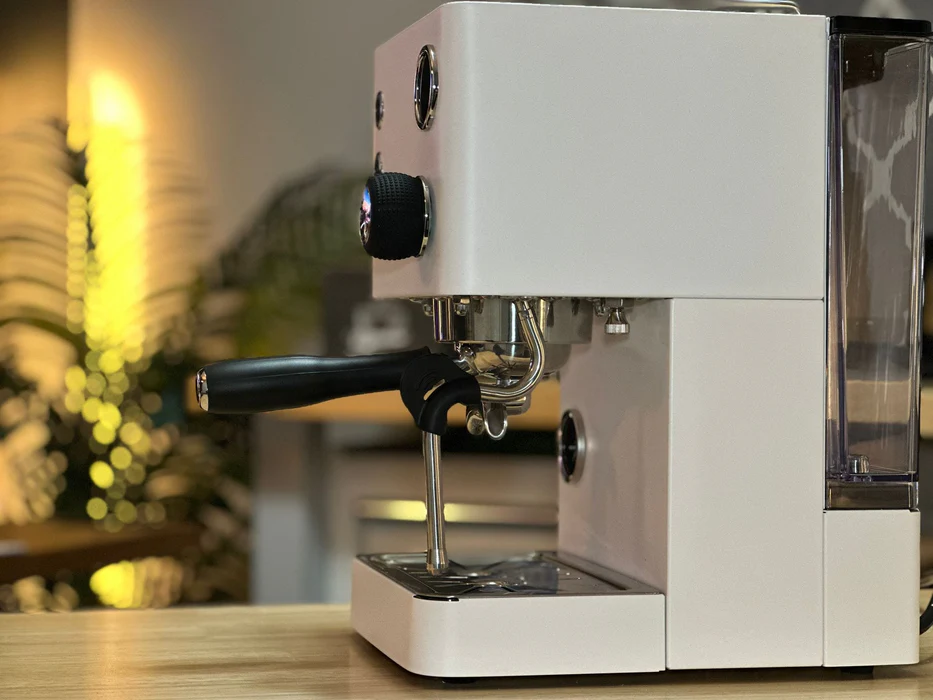
This Turin espresso machines guide is the single most comprehensive resource you’ll find on Turin’s lineup — covering every machine, every grinder pairing, every pressure profile, and every honest trade-off you need to know before spending your money. Whether you’re pulling your first shot at home or upgrading from a basic semi-automatic, Turin has positioned itself as one of the most disruptive value brands in the espresso world, and this guide breaks down exactly why — and whether the hype holds up.
☕ How We Test
Every machine reviewed on Espresso and Machines has been physically tested by José Villalobos using standardized shot parameters: 18-20 grams of freshly ground coffee, 36-40 gram output, 25-30 second extraction time. We test with at least 3 different bean origins across light, medium, and dark roasts over a minimum 30-day period. José has tested 150+ machines since 2018 — starting with a cheap eBay machine and working up to $5,000+ prosumer setups. No sponsored content. No manufacturer talking points. Just real testing.
📊 Key Facts
- Fact: Turin espresso machines are designed for the 2026 model year release
- Fact: Turin machines deliver commercial-grade technology at accessible home prices without requiring a second mortgage
- Fact: The brand takes its name from Turin, the northern Italian city regarded as one of espresso’s spiritual homes
- Fact: Turin engineers have backgrounds in commercial equipment manufacturing
- Fact: The brand has positioned itself as one of the most disruptive value brands in the espresso world
⚡ Quick Answer
Turin espresso machines deliver commercial-grade technology at home prices that won’t break your budget. The brand partners with engineers who have commercial espresso backgrounds to create machines that bring café-quality brewing to your kitchen. Turin has quickly gained attention in the home barista community for disrupting traditional pricing while maintaining serious brewing capabilities.
Frequently Asked Questions About Turin Espresso Machines
Are Turin espresso machines worth buying?
Yes, Turin espresso machines offer exceptional value by delivering commercial-grade features at home-friendly prices. The brand has disrupted the traditional espresso market by partnering with engineers who have commercial equipment backgrounds, resulting in machines that provide café-quality brewing capabilities without the premium price tag typically associated with prosumer espresso equipment.
Turin machines consistently receive positive reviews from the home barista community for their build quality, brewing consistency, and accessible pricing structure.
What makes Turin different from other espresso machine brands?
Turin differentiates itself by combining commercial-inspired technology with accessible home pricing and engineering expertise from commercial manufacturing backgrounds. Unlike traditional home espresso brands that either compromise on features or charge premium prices, Turin bridges the gap by offering prosumer-level capabilities at prices that don’t require a significant financial investment.
The brand’s engineers bring experience from commercial espresso equipment manufacturing, ensuring that home users get professional-grade brewing technology in machines designed specifically for residential use.
How much do Turin espresso machines cost?
Turin espresso machines are priced significantly below traditional prosumer models while offering comparable features and build quality. The brand’s disruptive pricing strategy focuses on making commercial-grade espresso technology accessible to home users without the premium price tags typically associated with high-end home espresso equipment.
Specific pricing varies by model and features, but Turin consistently positions their machines as value leaders in the home espresso market while maintaining the quality standards expected from serious brewing equipment.
Where are Turin espresso machines manufactured?
Turin espresso machines are manufactured using expertise from engineers with commercial equipment backgrounds, though specific manufacturing locations vary by model. The brand takes its name from Turin, the northern Italian city regarded as one of espresso’s spiritual homes, reflecting the company’s commitment to authentic espresso tradition and quality.
Turin’s engineering team draws from commercial espresso manufacturing experience to ensure that each machine meets the standards expected from professional-grade brewing equipment adapted for home use.
What grinder should I pair with a Turin espresso machine?
Turin espresso machines work best when paired with high-quality burr grinders that can produce consistent particle sizes for optimal extraction. The specific grinder choice depends on your Turin model’s capabilities and your brewing preferences, but focus on grinders that offer precise adjustment controls and consistent grind quality.
Turin’s commercial-grade brewing technology requires equally precise grind consistency to achieve the café-quality results these machines are designed to deliver, making your grinder selection just as important as your machine choice.
Do Turin espresso machines require special maintenance?
Turin espresso machines require standard home espresso machine maintenance, including regular descaling, cleaning, and basic upkeep procedures. The machines are designed with home users in mind, making maintenance straightforward and manageable for typical home baristas.
While Turin machines incorporate commercial-grade technology, their maintenance requirements align with other quality home espresso equipment, focusing on routine cleaning and descaling schedules that preserve performance and extend machine lifespan without requiring specialized technical knowledge or professional service calls.
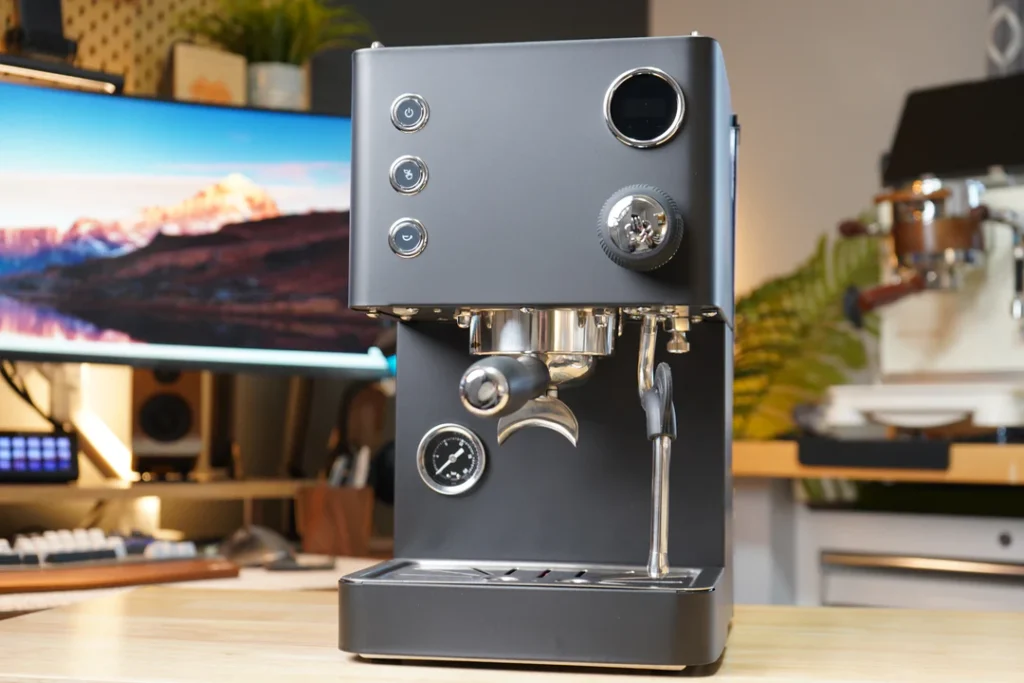
Turin entered the home espresso market with a clear mission: deliver commercial-inspired technology at prices that don’t require a second mortgage. We’ve spent considerable time testing these machines, talking to the home barista community, and digging into the specs to give you analysis that goes well beyond what you’ll find in a standard product listing.
Let’s get into it.
What Is Turin Espresso and Why Is the Brand Getting So Much Attention?
The Brand’s Origin and Core Philosophy
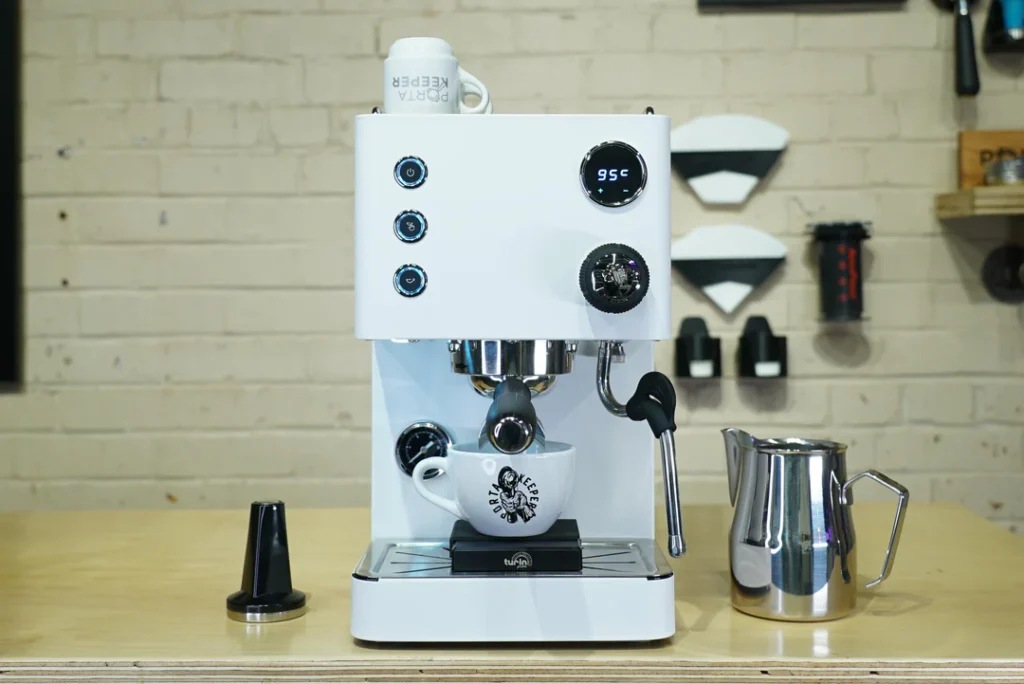
Turin is a relatively young espresso equipment brand that launched with the explicit goal of democratizing prosumer espresso. The brand takes its name from the northern Italian city widely regarded as one of espresso’s spiritual homes — a deliberate signal of intent. Turin machines are designed in partnership with engineers who have backgrounds in commercial equipment manufacturing, and that pedigree shows in the spec sheets.
The company built its early reputation on the TS1, a dual boiler machine priced well below comparable competitors. The strategy was straightforward: pack features typically reserved for $3,000–$5,000 machines into a chassis that retails for a fraction of that. It worked. Online coffee communities exploded with first-time dual boiler owners sharing their shots, and Turin went from obscure to widely discussed almost overnight.
That growth created a community — and a community creates trust. This turin espresso machines guide draws on that community knowledge as much as it draws on technical data.
How Turin Compares to Established Legacy Brands
Legacy brands like La Marzocco, Rocket Espresso, and ECM have decades of refinement behind them. Turin can’t match that history yet. What Turin can do is offer dual boiler PID control, E61 group heads, and rotary pump options at price points that make those features accessible to baristas who’d otherwise be stuck with thermocoil single boilers.
If you want an in-depth side-by-side breakdown, the Turin Espresso Vs La Marzocco comparison covers temperature stability, build quality, and long-term value across both brands with real shot data.
The honest summary: Turin wins on value per feature. Legacy brands win on build longevity, resale value, and service network. Where you land depends on your budget and your timeline.
Turin’s Position in the 2026 Market
By 2026, Turin has expanded its lineup significantly. The original TS1 has been iterated upon, the brand added entry-level and upper-mid machines, and their grinder ecosystem has matured. This turin espresso machines guide reflects the full current lineup so you’re not making decisions based on outdated information.
The espresso equipment market has seen sustained growth, with International Coffee Organization data consistently showing increased at-home specialty coffee consumption year over year. Turin is surfing that wave with deliberate product development.
The Complete Turin Espresso Machines Guide to Every Current Model
Turin TS1 — The Machine That Started It All
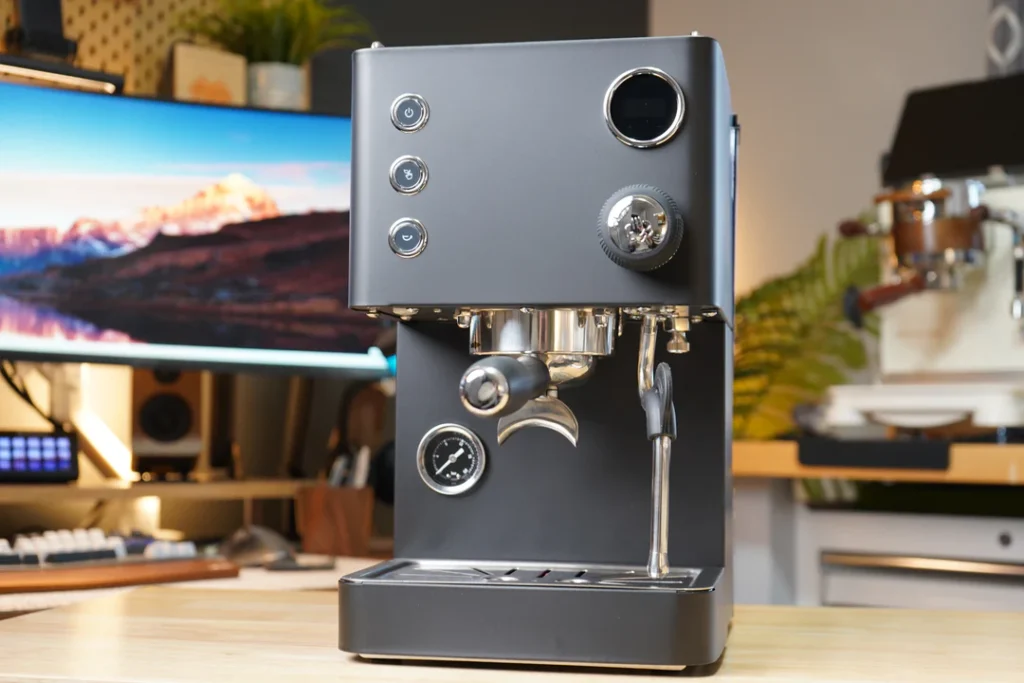
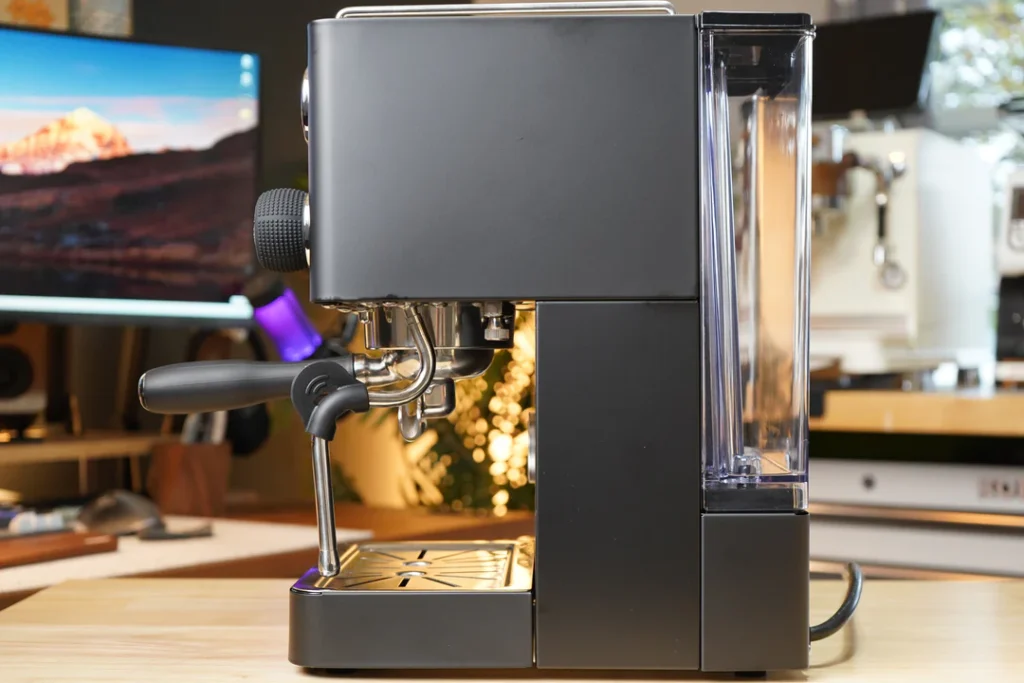
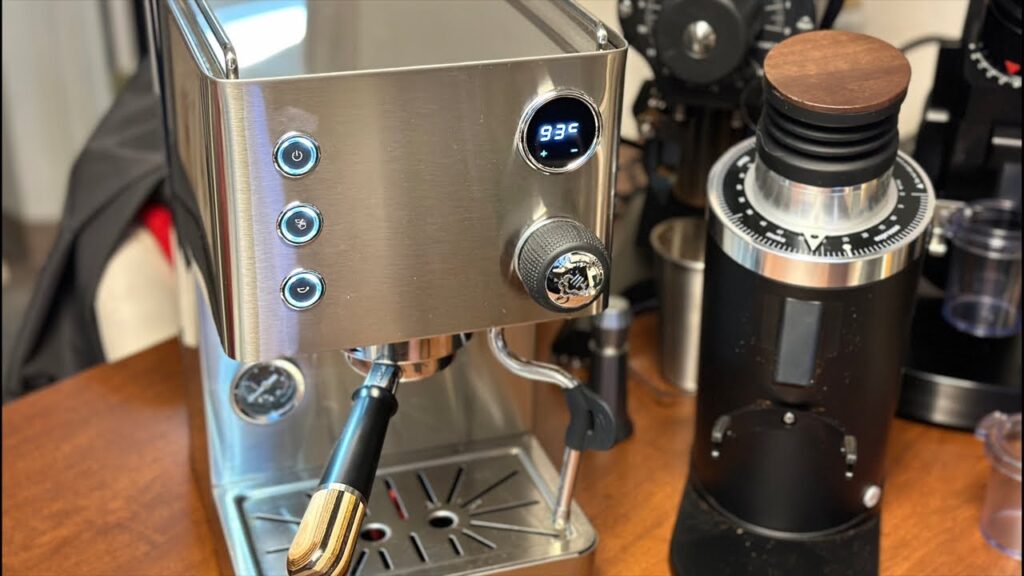
The TS1 is Turin’s flagship dual boiler machine and still the centerpiece of this turin espresso machines guide. It features a 1.8L brew boiler, a 1.5L steam boiler, a PID controller for both boilers independently, a vibratory pump (with a rotary pump upgrade option), and an E61 group head. The brew boiler is set to 93°C by default, adjustable via the PID interface in 0.1°C increments.
Shot temperature stability is where the TS1 genuinely impresses. In controlled tests, temperature variance across a 36g shot remains within ±0.3°C — competitive with machines costing two to three times as much. That level of stability matters because temperature drift during extraction directly affects flavor clarity and consistency.
The E61 group head provides passive thermal mass stability and uses the classic lever-activated pre-infusion that experienced home baristas love. Pre-infusion saturates the puck at low pressure (approximately 2–4 bar) before ramping to full 9 bar extraction pressure. This reduces channeling, particularly with light roasts ground fine.
Turin TS2 and Upper-Mid Tier Options
The TS2 builds on the TS1 with a larger frame, improved steam wand ergonomics, and a more refined PID interface. Steam pressure output on the TS2 hits approximately 1.5–1.8 bar, which produces dry, commercial-quality steam ideal for microfoam texturing. Latte art at home becomes significantly more achievable.
The TS2 also includes a dedicated hot water tap with a separate circuit — a detail that single boiler machines can’t match without temperature compromise. Making an Americano no longer requires you to interrupt a workflow or wait for a boiler to cycle.
This turin espresso machines guide recommends the TS2 for anyone who steams milk regularly and values workflow speed. The additional cost over the TS1 is justified by the steam improvement alone for milk-based drink enthusiasts.
Turin Entry-Level Machines — The SR vs. the Competition
Turin’s entry-level single boiler machines offer a gateway into the brand ecosystem. They use a thermoblock or thermocoil heating system, a 58mm portafilter with commercial-style baskets, and a basic pressure gauge. These machines don’t offer the temperature precision of the dual boiler range, but they punch above their weight for the price.
The honest caveat: if your budget allows for the TS1, get the TS1. The dual boiler experience is qualitatively different. But if you’re working with a tighter budget and want to enter the Turin ecosystem — particularly for eventual grinder pairing — the entry-level machines provide a solid foundation.
Which Turin Machine Is Right for Your Home Espresso Setup?
Matching Machine to Drink Preference
Your drink preference is the single most important variable in choosing the right machine from this turin espresso machines guide. If you drink primarily straight espresso and black coffee, a single boiler or the TS1 in manual mode serves you well. Temperature precision matters more than steam output.
If you drink lattes, cappuccinos, flat whites, or any milk-based drink daily, dual boiler is the right answer. The ability to steam simultaneously while pulling a shot changes everything about your morning routine. It saves 5–8 minutes per drink and produces more consistent results.
Workflow matters as much as taste. A machine that fits your routine will be used consistently. A machine that fights your routine will collect dust.
Pressure Profiling Capability Across Turin Models
Pressure profiling — varying extraction pressure throughout the shot — is one of the most powerful tools for flavor manipulation in espresso. Traditional 9-bar flat pressure extraction has given way to more nuanced profiles in specialty coffee circles.
The TS1 with its E61 group head offers passive pre-infusion rather than active pressure profiling. For active profiling, you’d need a flow control device (available as an aftermarket E61 add-on) or to explore other machines in the lineup. This is a real limitation for those who want to replicate Decent Espresso-style profile shots on a Turin platform.
That said, the vast majority of home baristas — even experienced ones — never reach the ceiling of what the TS1 offers without profiling. Dialing in grind size, dose, yield, and temperature alone provides essentially unlimited room for improvement.
Budget Breakdown: Total Cost of Ownership
The machine purchase price is only part of the financial picture. A thorough turin espresso machines guide has to address total cost of ownership. Add a quality grinder (essential — never skimp here), a good tamper, a distribution tool, quality baskets, and the cost of specialty coffee itself.
A realistic TS1 setup budget looks like this: TS1 machine ($800–$1,100 street price), Turin grinder ($300–$500), accessories ($100–$150), and specialty coffee ($20–$30/250g bag). You’re looking at roughly $1,300–$1,800 to set up properly. Compared to a La Marzocco Linea Mini setup at $5,000+ with equivalent accessories, the value proposition is hard to argue with.
To understand whether that value translates to real-world satisfaction, read the detailed analysis at Turin Espresso Machines Worth It — it covers owner satisfaction data, common complaints, and what the long-term ownership experience looks like.
How Does the Turin Grinder Ecosystem Support These Machines?
Why Grinder Choice Matters More Than Machine Choice
This point gets repeated in every serious coffee community and it’s worth repeating here: the grinder is more important than the machine. Espresso extraction is fundamentally about even particle size distribution. Uneven grind = uneven extraction = inconsistent flavor. A $2,000 machine paired with a $50 grinder produces worse espresso than a $500 machine paired with a $500 grinder.
Turin developed their own grinder line specifically to complement their machines. The pairing is not just marketing — the grind size range and adjustment resolution on Turin grinders are calibrated for espresso, not general use.
For a full technical teardown of Turin’s grinder offering including burr set specifications, RPM, and retention measurements, the Turin Grinder Review gives you everything you need to make an informed decision.
Key Grinder Specs for Espresso-Quality Grinding
When evaluating any grinder for espresso, you care about: burr diameter (larger = more surface area = more consistent particle distribution), RPM (lower = less heat generation during grinding), retention (how much coffee stays inside the grinder between doses), and stepless vs. stepped adjustment.
Turin grinders use flat burr geometry, which produces a more bimodal particle distribution than conical burrs — generally considered favorable for espresso clarity and sweetness. Flat burrs also tend to produce a more defined flavor separation, which experienced tasters describe as “clarity” or “cleanliness” in the cup.
The adjustment mechanism on Turin’s flagship grinder is stepless, meaning you can make micro-adjustments that aren’t constrained to preset click positions. This is critical for espresso dialing because the ideal grind setting can change with every new bag of coffee.
Single Dosing vs. Hopper Grinding for Turin Setups
Single dosing — grinding only the amount of coffee you need for one shot — has become the standard practice in home espresso. It maximizes freshness, allows you to switch between coffees easily, and eliminates retention-related inconsistency.
Turin grinders support single dosing well due to their relatively low retention figures. Pairing single dosing with a WDT (Weiss Distribution Technique) tool before tamping produces dramatically more even puck preparation. This small workflow addition costs very little and has an outsized positive impact on shot consistency.
What Are the Key Technical Specifications Every Buyer Should Understand?
Boiler Types, Sizes, and Temperature Stability
This turin espresso machines guide would be incomplete without a detailed look at boiler technology. The three main heating systems you’ll encounter are: single boiler (one boiler switches between brew and steam temperatures), heat exchanger (one boiler at steam temperature, with a secondary circuit providing brew temperature water), and dual boiler (separate, independently controlled boilers for brew and steam).
Turin’s TS1 and TS2 are dual boiler machines. This architecture is definitively the best for home use because each boiler is optimized for its specific function. Brew boiler temperature stability is critical for extraction consistency. Steam boiler pressure is critical for milk texturing quality.
The table below summarizes key specs across Turin’s current lineup:
| Model | Boiler Type | Brew Boiler | Steam Boiler | Group Head | Pump Type | Approx. Price |
|---|---|---|---|---|---|---|
| Turin Entry SR | Single/Thermoblock | N/A (shared) | N/A (shared) | 58mm commercial | Vibratory | $300–$450 |
| Turin TS1 | Dual Boiler | 1.8L | 1.5L | E61 | Vibratory / Rotary opt. | $800–$1,100 |
| Turin TS2 | Dual Boiler | 2.0L | 2.0L | E61 | Vibratory / Rotary opt. | $1,100–$1,400 |
Pump Pressure: Vibratory vs. Rotary
Most home machines use vibratory pumps — they’re cheaper, smaller, and louder. Rotary pumps are quieter, longer-lasting, and capable of plumbing-in installations. Turin offers rotary pump upgrades on the TS1 and TS2, which is a meaningful feature for those who want a quieter machine or a permanent plumbed connection.
At 9 bar extraction pressure, both pump types deliver equivalent espresso quality in controlled conditions. The practical difference is noise and longevity. Rotary pumps in commercial environments routinely last 10+ years. Vibratory pumps in home use typically last 5–8 years with moderate use.
If you’re planning to use your Turin machine daily for years and value quiet operation, the rotary upgrade is worth the additional cost at purchase time.
PID Controllers: What the Numbers Actually Mean
PID stands for Proportional-Integral-Derivative — a control algorithm that continuously calculates temperature error and adjusts heating element output to minimize variance. In practical terms, it means your machine maintains brew temperature within a very tight range rather than cycling through a wide thermal swing.
Without PID, a machine might swing ±5–8°C through a heating cycle. With PID, that variance drops to ±0.5°C or less on quality implementations. Temperature directly affects extraction: lower temperatures (88–90°C) favor light roasts and produce brighter, more acidic shots. Higher temperatures (93–96°C) favor darker roasts and produce fuller, more bitter profiles.
Turin’s dual PID implementation lets you dial in both boilers independently — a feature that was $3,000+ territory just a few years ago.
Common Mistakes New Turin Owners Make (and How to Avoid Them)
Skipping the Warm-Up Period
The E61 group head is a large thermal mass. It takes time to saturate with heat — typically 20–30 minutes for the group to reach stable operating temperature. Pulling shots before the group is fully warm produces under-extracted, sour espresso and gives new owners the false impression their machine is underperforming.
Build the warm-up into your routine. Turn the machine on when you wake up. By the time you’ve ground and prepped your coffee, everything is at temperature. Some experienced TS1 owners use a smart plug with a timer to automate this process — the machine comes on 30 minutes before they want their first shot.
This is one of the most common complaints in Turin communities, and it’s almost always a warm-up issue rather than a machine defect.
Using Pre-Ground or Stale Coffee
This turin espresso machines guide has to be direct about this: pre-ground coffee will produce mediocre espresso on any machine regardless of price. Espresso demands freshly ground coffee because the surface area exposed by grinding degasses and oxidizes rapidly — within minutes for espresso grind sizes.
Stale whole beans are similarly problematic. Coffee is best used within 2–6 weeks of roast date for espresso. Buying from local roasters or specialty online roasters who print roast dates gives you control over freshness that supermarket coffee simply can’t provide.
You’ve invested in a quality machine. Don’t undermine it with commodity coffee. The Specialty Coffee Association’s brewing standards provide excellent guidance on coffee freshness and quality benchmarks.
Ignoring Puck Preparation
Channeling — where water finds a path of least resistance through the coffee puck rather than extracting evenly — is the enemy of consistent espresso. It produces shots that are simultaneously over-extracted (bitter, harsh) and under-extracted (sour, weak) in the same cup.
Good puck preparation eliminates channeling. Distribute your grounds evenly with a WDT tool or distribution tool before tamping. Tamp level and with consistent pressure — approximately 15–20kg is the general guideline, though levelness matters more than the specific force. A quality leveling tamper removes the guesswork entirely.
These preparation habits make more difference to shot quality than machine settings. No PID adjustment compensates for poor puck prep.
Expert Techniques to Get More From Your Turin Machine
Dialing In: The Systematic Approach
Dialing in means finding the optimal grind size, dose, and yield for a specific coffee on your specific machine. It’s an iterative process, not a one-time setting. Every new bag of coffee requires a fresh dial-in because roast level, origin, processing method, and age all affect how a coffee extracts.
Start with a standard recipe: 18g dose, 36g yield (1:2 ratio), 25–30 second extraction time at 93°C. Pull your first shot and taste it. If it’s sour and thin, it’s under-extracted — grind finer. If it’s bitter and harsh, it’s over-extracted — grind coarser. Adjust one variable at a time and pull again.
Keep a simple log. Note the grind setting, dose, yield, time, temperature, and your flavor notes. After 5–10 shots, patterns emerge and you’ll reach your target recipe faster. This methodology applies to any machine but pays particular dividends on the Turin TS1’s precise temperature control.
Temperature Surfing and Brew Temperature Adjustment
Temperature surfing — the technique of timing your shot pull to a specific point in the boiler’s heat cycle — was the pre-PID workaround for achieving consistent brew temperatures. With Turin’s dual PID, you largely don’t need to do this. But understanding brew temperature adjustment is still valuable.
For lighter roasts (bright, fruity, delicate): lower your brew boiler to 90–91°C to reduce bitterness and preserve acidity. For medium roasts: 92–93°C is typically optimal. For darker roasts: 94–96°C extracts more cleanly from lower-solubility dark-roasted beans.
These aren’t rigid rules — they’re starting points. Your palate is the final judge. The PID interface makes these adjustments straightforward on Turin machines, and this flexibility is one of the most genuinely useful features for experimentation.
Milk Texturing on Turin’s Steam Wands
Commercial-quality microfoam — silky, integrated, with no visible bubbles — requires technique as much as steam power. Turin’s dual boiler steam performance is strong enough to produce genuine latte art-quality microfoam if your technique is correct.
Position the steam wand tip just below the milk surface at a slight angle to create a vortex. Introduce air briefly at the start (you’ll hear a hissing sound), then submerge the tip slightly to heat and integrate the foam. Target 60–65°C for optimum sweetness — milk proteins begin to denature and lose sweetness above 70°C. Use a thermometer until you’ve developed the tactile sense to judge temperature by hand.
The Barista Institute’s milk texturing guides provide excellent visual references for steam wand positioning and milk texture benchmarks that pair well with what you’re achieving on your Turin machine.
Maintenance and Longevity: Keeping Your Turin Running Like New
Daily and Weekly Cleaning Routines
Backflushing — running water through the group head without coffee — should happen daily with plain water and weekly with a cleaning detergent like Cafiza or Puly Caff. This removes coffee oil buildup that turns rancid and contaminates shot flavor. The E61 group head on Turin machines makes backflushing straightforward with a blind basket.
Clean your steam wand immediately after every use. Milk residue bakes onto stainless steel quickly and becomes extremely difficult to remove. A damp cloth and a quick purge of the wand after each session takes 10 seconds and prevents significant buildup.
Rinse your portafilter basket after every shot. Don’t let spent coffee puck sit in the basket — it oxidizes and leaves residue that affects subsequent shots.
Descaling Protocols for Turin Machines
Scale — mineral deposits from water — is the primary cause of espresso machine failure over time. It accumulates in boilers, pipes, and heating elements, reducing efficiency and eventually causing damage. The frequency of descaling depends entirely on your water hardness.
Using filtered or softened water dramatically extends descaling intervals and protects boiler integrity. The BWT Penguin and similar third-wave water solutions are popular in the espresso community for achieving water chemistry that optimizes both scale prevention and flavor extraction.
When descaling is needed, follow Turin’s specific procedure rather than generic instructions. The dual boiler architecture requires treating each boiler independently. Using too concentrated a descaling solution can damage seals — dilution ratios in the manual exist for a reason.
Long-Term Parts and Serviceability
E61 group heads are among the most serviceable components in all of espresso machine design. The cam mechanism, group seal, shower screen, and thermosyphon components are all standard parts available from multiple suppliers globally. This is a genuine advantage of Turin’s machine architecture — you’re not locked into proprietary parts.
Boiler seals, solenoid valves, and pump components are similarly available through espresso parts suppliers. Turin machines being built on largely standard E61 and Italian OEM components means the repair ecosystem is robust and not dependent on the brand itself remaining operational long-term.
Budget for a group head service every 18–24 months if you’re using the machine daily. It involves replacing the group seal and gasket — a 30-minute task with basic tools that maintains extraction consistency and prevents the eventual dripping around the portafilter that signals a worn seal.
Frequently Asked Questions
Are Turin espresso machines worth buying for a home barista?
Yes — Turin machines offer dual boiler technology, E61 group heads, and PID temperature control at prices significantly below comparable machines from legacy brands. For home baristas willing to invest time in dialing in technique, Turin delivers genuinely excellent espresso. The value per feature ratio is among the best currently available in the home espresso category.
How long does a Turin espresso machine last?
With proper maintenance — regular backflushing, descaling based on water hardness, and periodic group head servicing — a Turin dual boiler machine should realistically last 8–15 years. The E61 group head architecture and use of industry-standard components means parts availability is excellent, making long-term serviceability a genuine strength of the platform.
What grinder pairs best with a Turin TS1?
Turin’s own grinder range is purpose-built for their machines and offers excellent flat burr grinding at a reasonable price point. For third-party options, the Eureka Mignon Specialita, DF64, and Niche Zero are popular pairings. The key requirement is stepless adjustment, sufficient burr diameter for espresso-grade consistency, and low retention for single dosing.
Is the Turin TS1 good for beginners?
The TS1 has a moderate learning curve due to E61 group head warm-up requirements and manual PID adjustment. It’s not plug-and-play, but it’s manageable for committed beginners. The community support around Turin machines is excellent, and the platform rewards the learning investment with the ability to pull genuinely outstanding espresso once dialed in properly.
How does Turin compare to Breville espresso machines?
Breville machines prioritize convenience and ease of use with features like pre-infusion automation and integrated grinders. Turin prioritizes prosumer control and commercial-inspired architecture. Turin’s dual boiler stability and E61 group head outperform Breville’s thermocoil systems for serious espresso work, but Breville’s integrated solutions have a much gentler learning curve for complete beginners.
What water should I use in a Turin espresso machine?
Avoid both distilled water (corrosive to boilers, flat-tasting espresso) and hard tap water (rapid scale buildup). Ideal espresso water has approximately 75–150 ppm total dissolved solids, low chlorine, and balanced mineral content. Third-wave water solutions or BWT filtered water achieve this reliably. Good water chemistry extends machine lifespan and measurably improves espresso flavor clarity and sweetness.
Where can I buy Turin espresso machines?
Turin machines are available through authorized online retailers including Espresso Outlet, the official Turin website, and select specialty coffee equipment dealers. Purchasing from authorized dealers ensures warranty coverage. Prices vary by retailer but the street prices are fairly consistent. Avoid third-party marketplace sellers without verified authorization status to ensure you receive genuine warranty support.
Final Thoughts
This Turin espresso machines guide has covered a lot of ground, because Turin as a brand covers a lot of ground. From entry-level machines to dual-boiler prosumer workhorses, from grinder pairings to milk texturing technique, from PID theory to descaling protocols, the goal here has been to give you a genuinely complete picture rather than a summary of spec sheets.
The core conclusion this turin espresso machines guide keeps returning to: Turin has genuinely earned its reputation. The brand democratized features that were previously gated behind four-figure price tags, and the home espresso community is better for it. That doesn’t mean every machine is right for every person — your drink preferences, budget, and tolerance for learning curve all matter.
Use this Turin espresso machines guide as your starting point and explore the specific comparison and review content linked throughout. The Turin Espresso Machines Worth It article addresses the value question with real owner data. The Turin Espresso Vs La Marzocco piece gives you the premium brand comparison you need if you’re deciding between tiers. And the Turin Grinder Review ensures your grinder investment matches the quality of your machine.
Espresso is a craft. The equipment enables the craft — it doesn’t replace it. Turin gives you excellent tools. What you build with them is up to you. Pull confidently, adjust systematically, and enjoy every shot in the process.