De Longhi 15 Bar and 19 Bar, as the Instruction Manuals State Them
De'Longhi states pump pressure in MPa first and bar second. Three model families state 1.5 MPa, two state 1.9 MPa, and no manual says the higher figure brews better coffee.
De’Longhi states pump pressure in its instruction manuals as 1.5 MPa (15 bars) or 1.9 MPa (19 bars), and the figure separates model families rather than describing a quality difference the documents claim anywhere.
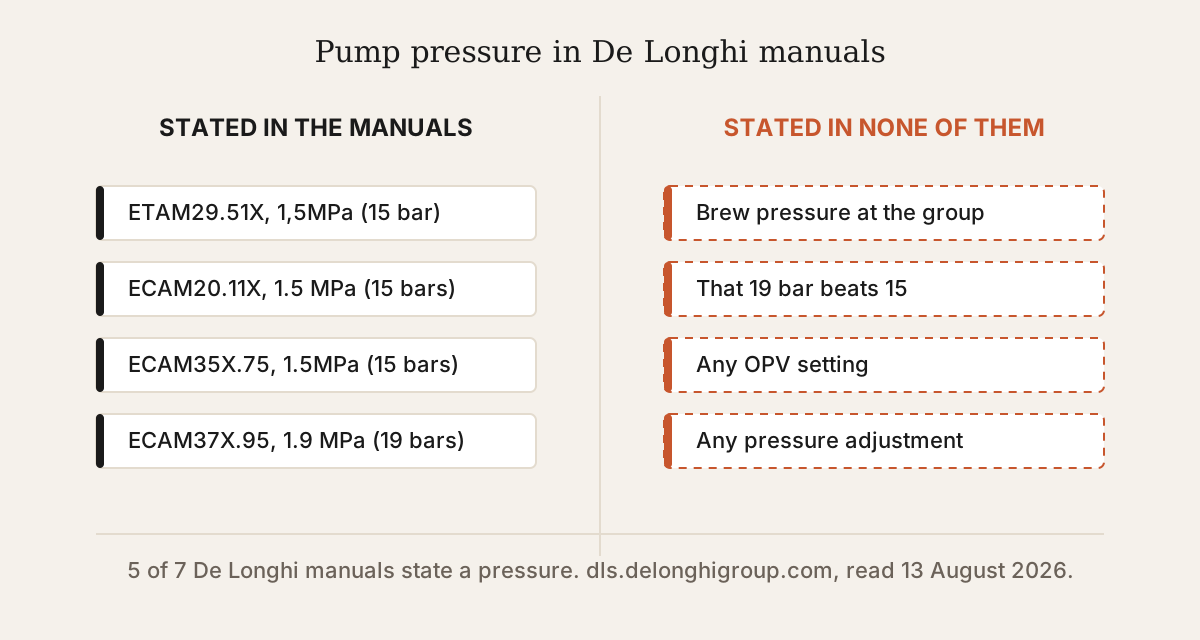
Which models state which figure
Seven De’Longhi instruction manuals were downloaded from the company’s own document server on 13 August 2026. Five carry a pressure specification.
| Model | Pressure as printed | Document | URL |
|---|---|---|---|
| ETAM29.51X | 1,5MPa (15 bar) | 5713226261, stamp 5713226261/12.14 | dls.delonghigroup.com/files/docs/5/EN-5713226261.pdf |
| ECAM20.11X / 21.11X / 22.11X | 1.5 MPa (15 bars) | 5713227471 | dls.delonghigroup.com/files/docs/5/EN-5713227471.pdf |
| ECAM35X.75 | 1.5MPa (15 bars) | 5713229761 | dls.delonghigroup.com/files/docs/5/EN-5713229761.pdf |
| ECAM37X.95 | 1.9 MPa (19 bars) | 5713238071 | dls.delonghigroup.com/files/docs/5/EN-5713238071.pdf |
| model not identifiable from the document text | 1.9 MPa (19 bars) | 5713248482 | dls.delonghigroup.com/files/docs/5/EN-5713248482.pdf |
The counting rule: a model counts as stating a pressure when the figure appears in that document’s technical data table. Five of seven documents state one. The other two, 5713218781 for the ESAM6900 and 57132C9061 for the ECAM11.1XX, do not carry the figure in an extractable technical data table.
All seven URLs returned HTTP 200 with no login. They sit on dls.delonghigroup.com, De’Longhi Group’s own document server.
The unit De’Longhi leads with is MPa, not bar
Every one of the five states megapascals first and bar second. The printed forms are 1,5MPa (15 bar), 1.5 MPa (15 bars), 1.5MPa (15 bars), 1.9 MPa (19 bars).
Quoting 19 bar alone drops the unit the manufacturer leads with, and the punctuation varies between documents, including a comma decimal separator in the ETAM manual. Where this page quotes a figure it quotes the string as printed.
What separates the two families in the documents
The 19 bar documents are also the ones carrying a wireless frequency specification.
| Model | Pressure | Wireless band stated | Weight |
|---|---|---|---|
| ETAM29.51X | 1.5 MPa | none | 9,1 kg |
| ECAM20.11X | 1.5 MPa | none | 8.9 kg |
| ECAM35X.75 | 1.5 MPa | none | 9.9 kg |
| ECAM37X.95 | 1.9 MPa | 2400/2483.5 MHz | 10 kg |
5713248482 | 1.9 MPa | 2400/2500 MHz | 11.2 kg (varies according to model) |
That is an observation about which documents contain which fields, not a claim. No De’Longhi document states that the 19 bar machines are a newer connected range, and this page does not state it either.
What no De’Longhi manual states about the pressure figure
Checked across all seven documents on 13 August 2026.
- No brew pressure at the group. The figure specified is the pump rating. No document states the pressure the coffee is actually extracted at.
- No claim that 19 bar extracts better than 15. Neither number is described as an advantage anywhere in the seven.
- No OPV setting and no pressure adjustment procedure.
- No statement that the pressure specification is comparable to another manufacturer’s.
A pump rating and a brewing pressure are different claims. Gaggia’s service manual makes the gap explicit by publishing both, a 15 bar pump and a maximum hydraulic circuit pressure of 11 +1/-0,5 bar. De’Longhi publishes only the first, so the second is unestablished for these machines.
One line De’Longhi prints that applies to all of this
Quoted from document 5713248482:
De Longhi reserves the right to modify the technical specification and styling of its products at any moment
Which is why every figure on this page is dated to the day the document was read, 13 August 2026, and names the document ID it came from.