The Documents You Can Find But Cannot Read
Slayer publishes parts diagrams. Google lists them by title. The pages need JavaScript to render, so the documents are findable and unreadable at once. Nuova Simonelli does the same thing.
There is a state between published and withheld that nobody names, and two makers in this survey are in it.
Slayer publishes parts diagrams. You can find them. You cannot read them.
Search returns their titles: SLAYER Parts Diagrams - 2026, SLAYER Parts Diagrams - Legacy, SLAYER Critical Components - 2025, Circuit Board Wiring - Steam Series. The articles are on Slayer’s own knowledge base, they require no login, and the URLs return HTTP 200. Request one and you get a 25,078-byte application shell containing no document at all. The content is assembled by JavaScript after the page loads. A browser sees it. Anything that does not execute scripts sees nothing.
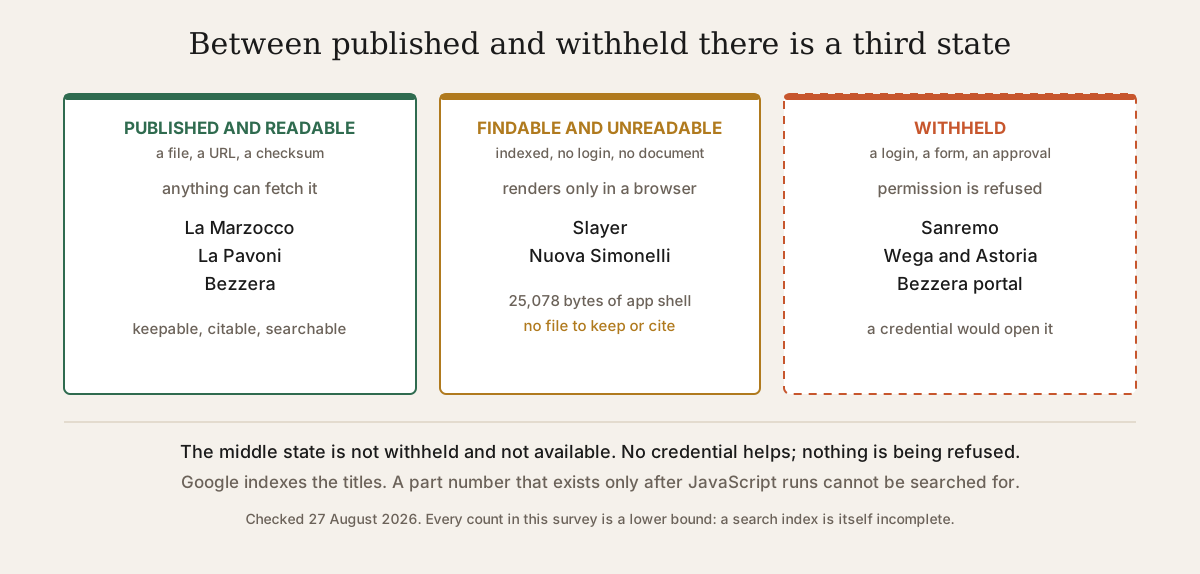
Three states, not two
Published and readable. The maker puts a file on a server and anything can fetch it. La Marzocco, La Pavoni and Bezzera publish parts catalogues this way.
Withheld. A login, a trade approval, or a form stands between the reader and the document. Wega and Astoria do this, behind a shared trade portal that names its own contents.
Findable and unreadable. The document is public, indexed, and requires a rendering engine to exist as text. It is not withheld and it is not available. No credential would help you. No permission is being refused. The document simply does not resolve into anything you can read, quote, archive or search.
That third state is the subject of this page, and it is the one with no name in any discussion of manufacturer documentation we have found.
What can be established without reading them
Search snippets are a search engine’s own extraction of the rendered page, so they establish subject and existence without establishing contents.
“Parts Diagrams - 2026 - Updated Quarterly. SLAYER parts diagrams are for spare part identification and troubleshooting by experienced espresso technicians.”
“legacy parts diagrams are for instructional and historic reference only. Part numbers, prices, and compatibility may no longer…”
One snippet carries a part number outright: 30005-10080-02 Steam LP Board.
So Slayer publishes parts diagrams, updated quarterly, carrying part numbers, aimed at technicians. That much is established. What those diagrams contain, which machines they cover, and whether any of them states that a part fits more than one model, are not.
A title in an index is evidence an article exists on that subject. It is not evidence of what the article says.
Nuova Simonelli’s archive is the same wall
This would be an anecdote with one instance. It has two.
Nuova Simonelli and Victoria Arduino share a documentation archive that publishes user manuals, specification sheets and a catalogue of individual part numbers, openly, with no form. We can fetch specific documents from it. We cannot enumerate it: the index page requires JavaScript and the site’s sitemap returns an application shell rather than a list of pages.
So the archive’s contents are partly readable and its extent is not. We can tell you documents exist and serve. We cannot tell you how many.
Two makers, the same wall, built the same way and almost certainly not on purpose. Neither is hiding anything. Both chose a documentation platform that renders in a browser, and the consequence is that their documents are invisible to every reader that is not one.
Who this actually shuts out
Not the technician with a laptop. They open the page and it works.
It shuts out everything that reads at scale. Archives. Offline copies. Search within a document. Anyone building a reference across brands. A part number that exists only after JavaScript runs cannot be found by searching for the part number.
It also shuts out durability. A file has a URL, a size and a checksum, and can be kept. A page that assembles itself from an API has none of those, and when the platform changes the document does not move, it stops existing in the form anyone recorded.
One paragraph about our own error, because it is the proof the wall works
We recorded Slayer as publishing no parts catalogue, no exploded diagram and no part number list. In the same record we wrote that the portal was client-rendered and that no article list could be derived from it. We noted that we could not see inside the container, and then described what was not in it. The parts diagrams had been indexed by Google the whole time. A researcher who documented the wall in one sentence walked into it in the next, which is a fair measure of how well it works.
What this does to the survey’s counts
Slayer leaves the set of makers that state a refusal about parts. Its published sentence, “If you need to place a Parts order, please email orders@slayerespresso.com. Please include your serial number in your message,” routes ordering. It says nothing about publishing documents, and routing an order is not withholding one.
It does not join the makers that publish parts documents openly either, because those articles cannot be read.
Three of 28 makers now state a refusal about parts in their own published words: Jura, Synesso and Siemens. That figure was five when this survey began. It has changed three times, and once the count held at five while the membership rotated underneath it, which is why the set is tracked by membership rather than by number.
Counts derived 27 August 2026. Every count in this survey is a lower bound: search indexes are themselves incomplete, and we report what we found.
What to do if you need one of these documents
Open it in a browser. That is what it is built for and it will work.
Do not expect to keep it. There is no file to download, so save what you need as you read it, including the part numbers you care about.
Give the part number, not the page. A page you cannot cite is a poor reference. 30005-10080-02 is one anybody can use.
What the searches say
slayer espresso parts carries 20 searches a month and slayer parts 10. slayer serial number, the identifier the ordering route requires, has never been measured at all. That is consistent with every gated brand we tested: seven of seven plain-language phrasings measured, and fifteen of nineteen maker-required identifier phrasings never measured.
Provider DataForSEO, Google Ads keyword planner, United States, English, read 26 and 27 August 2026. Modelled figures, not observed traffic. SERP read the same days, 10 of 10 organic results on topic for both queries.