The Gaggia Classic Parts List, as Published
Gaggia publishes a Classic parts diagram with 90 numbered parts. Its numbers do not map to the newer Evo 12NC scheme and no published document connects them.
Gaggia publishes a Classic parts diagram carrying 90 numbered parts, each with a position number and an article number, and it is the only parts list of the five espresso brands examined.
Where the list is published
The diagram is identified on its own face as ER0182, CLASSIC, CLASSIC COFFEE GAG, and is linked from the Gaggia North America Classic manuals page at gaggia-na.com/pages/gaggia-classic-manuals.
That page also links a quickstart guide, a full manual, an electrical diagram and a performance test, none of which requires a login. The page is the citable address. The PDF files themselves are served from a generic storage bucket whose URL is not self-evidently official and may rotate.
What the list contains
Ninety parts, of which 88 carry a description. A sample, transcribed from the document:
| Pos | Article number | Description |
|---|---|---|
| 2 | CF0113 | LID |
| 3 | CF0115 | FUNNEL |
| 8 | DM0041/081 | O-RING 112 IN EPDM 70 SH |
| 12 | DM1288 | STEAM TEMPERATURE SWITCH |
| 13 | EF0030/A | ALUM.BOILER 120/220/240 V ASSY. |
| 43 | 12000140 | ULKA PUMP EP5/S GW 230V-50HZ |
| 43 | 12000142 | ULKA PUMP EAP5/S 120V-60HZ |
| 48 | 8332018000 | FILTER BASKET (CHROM.) |
| 53 | CC5021 | BLACK RUBBER FOOT |
Source: ER0182 parts diagram, linked from gaggia-na.com/pages/gaggia-classic-manuals. Checked 13 August 2026.
Note position 43: the document lists two pump part numbers at one position, one for 230V 50Hz and one for 120V 60Hz. Market variance is recorded in the parts list itself.
The two numbering schemes, and the gap between them
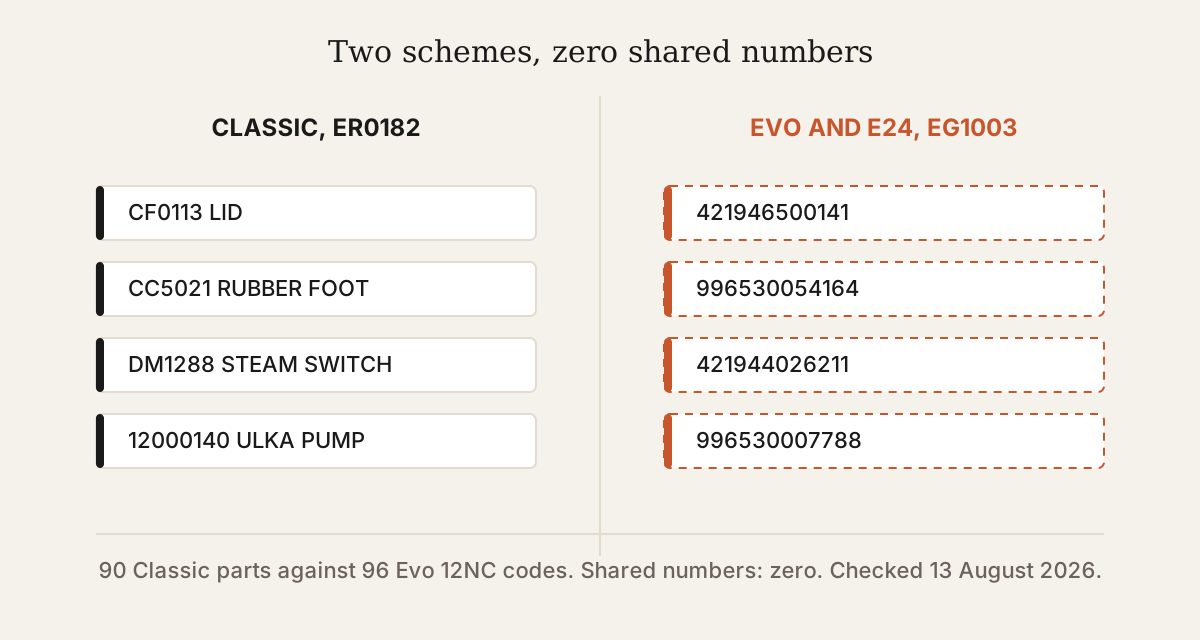
Gaggia’s older Classic parts list and its newer Evo and E24 diagram share zero part numbers.
The Classic list uses prefixed codes such as CF0113, CC5021 and DM1288, plus numeric codes of eight to ten digits. The Evo and E24 diagram, Exp.EG1003 Rev.01 - 06/07/23, uses twelve-digit Philips 12NC codes such as 421946500141 and 996530054164.
Every Classic part number was compared against every Evo 12NC code on 13 August 2026, by exact match, by substring and by suffix. The intersection is zero in all three tests.
No published Gaggia document maps one scheme to the other, so a part cannot be traced from the older machine to the newer one through the manufacturer’s own documentation.
What a shared description does and does not establish
Twenty-two descriptions appear in both documents, and a shared description is not a shared part.
The counting rule: two descriptions match when they are identical after upper-casing, replacing every non-alphanumeric character with a space, and collapsing runs of spaces. No partial or fuzzy matching was used, so the figure is the strictest of the available readings.
Both list BLACK RUBBER FOOT. Both list STEAM TEMPERATURE SWITCH. Both list SCREW TSP M5X8 UNI 7688 DIN 965 INOX, which cites two international standards and is very likely interchangeable.
Very likely is not what the documents state. The publishable form is that both documents specify a DIN 965 M5x8 stainless screw, which is a statement about the documents. That a given part fits both machines is a claim no published Gaggia source makes.
The Evo and E24 list, recovered from the same publisher
The second Gaggia parts document, exploded view Exp.EG1003 Rev.01 - 06/07/23, carries 79 numbered parts with a 12NC code and a description for each. Positions run from 101 to 248. Counting rule: a row counts when a three-digit position, a twelve-digit 12NC and a description sit on one line of the document, read by coordinate rather than by text order. 79 rows, 79 distinct positions, 79 distinct 12NC codes, read 13 August 2026.
A representative extract, quoted as printed:
| Pos | 12NC | Description |
|---|---|---|
| 207 | 421941305991 | ULKA PUMP EP5FMGW 230V-50HZ RI9481 |
| 218 | 421946504771 | THERMOSTAT 145°C M4X0.7 PLASTIC CASE RI9481 |
| 219 | 421946504761 | THERMOSTAT 107°C M4X0.7 PLASTIC CASE RI9481 |
| 221 | 996530055406 | COATED ALUM.BOILER ALU.BOILER 120/220/230/240 ASSY |
| 202 | 421941312261 | CPU+SW ECO-SWITCH RELE 20MIN 230V ASSY 230V-UK only |
| 232 | 421944093701 | BRASS 57 SOLENOID VALVE V2 230V 50HZ 230V-UK-AU |
| 217 | 996530056298 | BRACKET FOR THERMOFUSE |
| 131 | 421946510601 | SS FILTER HOLDER/KNOB ASSY |
Two of those rows state a temperature. The thermostats are specified at 145°C and 107°C in their own descriptions, which is the only place in the published Gaggia set where a temperature is attached to a component.
Three rows carry a market qualifier inside the description, such as 230V-UK only and 230V-UK-AU, so a part number read without its qualifier can name a component that is not fitted to the machine in front of you.
Why this table was previously reported as unrecoverable
The document lays its parts table in two side-by-side column groups and draws every string twice. Read in text order, the two groups interleave and each token repeats, which is why an earlier reading of this document reported positions, codes and descriptions as three separate sets that could not be joined.
Splitting the words by their x coordinate at the page midline and dropping the doubled draw returns the rows intact. The correction is recorded rather than applied silently, because the earlier reading is quoted in this site’s own working notes.
This does not change what the two documents do not do. ER0182 and EG1003 still share no part number, so nothing here connects an older Classic part to an Evo part.
What the diagram does not carry
The document has no date on its face, and two of its ninety rows have no recoverable description.
The undated status matters for citation: the revision can be named as ER0182 and nothing more precise. The two rows without descriptions are positions 30 and 68, where the position number and the article number are both legible and the description text did not extract.