The Gaggia Classic Service Manual, and What Is In It
Gaggia publishes a service manual for the Classic 2019 and Classic Evo Pro, revision 04 dated 25 September 2023. It is the only one of five brands that does.
Gaggia publishes a service manual covering the Classic 2019 and the Classic Evo Pro, identified on its own face as revision 04, dated 25 September 2023, and it downloads without a login.
Where it is published
The document is linked from the Gaggia North America page at gaggia-na.com/pages/gaggia-classic-pro-evo-e24-manuals, alongside a full manual for the Evo and Pro, a full manual for the E24, and a parts diagram.
That page is the citable address. The file itself is served from a storefront CDN whose URL is not self-evidently official and may rotate, so a citation should name the page rather than the raw file.
What the manual contains
A technical specification table, a hydraulic circuit diagram, an electrical diagram, disassembly procedures, a tightening torque table and a troubleshooting matrix.
Its own contents list names, among others: Specific tools and equipment, Maintenance Products, Safety warnings, Water circuit diagram, Electrical diagram, External machine parts, Internal machine parts, Technical specifications, Troubleshooting, Disassembly, Outer Shell, Pump and electrical connection, Steam tube, Boiler, Fitting and removing Oetiker clamps, Tightening torques.
The specification table, and the one difference it records
The manual tabulates the Classic 2019 and the Classic Evo Pro side by side, and one row differs.
The machines are distinguished by type code: SIN035UR is the stand-by version and SIN035R is the no
stand-by version.
| Specification | SIN035UR, stand-by | SIN035R, no stand-by |
|---|---|---|
| Automatic shut-off | Yes (20 min.) | No |
| Pump pressure | 15 bar | 15 bar |
| Water tank capacity | 2,1 l | 2,1 l |
| Boiler | Aluminium | Aluminium |
| Size in cm, L x H x D | 23 x 38 x 24 | 23 x 38 x 24 |
| Weight | 7,3 kg | 7,3 kg |
| Control panel | Rocket buttons + indicator lights | Rocket buttons + indicator lights |
| Professional filter-holder | Yes | Yes |
| Bodywork | Brushed stainless steel | Brushed stainless steel |
| By-packed filters | 1 Crema perfetta, 2 Traditional | 1 Crema perfetta, 2 Traditional |
Source: service manual, revision 04 dated 25 September 2023, Technical specification section. Checked 13 August 2026.
Automatic shut-off is the only functional difference the table records. That is narrower than two separately marketed generations would suggest, and the manual states no difference in boiler, pressure, capacity, dimensions or weight because none is tabulated.
Power supply varies by market rather than by generation. The stand-by version is tabulated at
230V 50Hz 1200W and 240V 50Hz 1300W. The no stand-by version is tabulated at 100V 50/60Hz 1150W,
120V 60Hz 1350W, 220V 60Hz 1150W and 240V 50Hz 1300W.
Figures the manual states that appear nowhere else
Three figures in this document are not published by any of the other four brands examined.
| Figure | Value | Section |
|---|---|---|
| Maximum hydraulic circuit pressure | 11 +1/-0,5 bar | Safety warnings |
| Insulation class | class 1 | Safety warnings |
| Water temperature in tank, for measurement | 23 C (+/-2 C) | Coffee temperature measurement |
The maximum circuit pressure and the pump rating are different claims. The specification table in the same manual states a pump pressure of 15 bar. Writing that the machine brews at 15 bar would misstate the document.
What the manual says about parts
It carries an explicit instruction about component sourcing, quoted verbatim from the parts documentation it accompanies:
Only use genuine Gaggia spare parts to replace critical components.The warranty of your Gaggia product is void if you do not use genuine Gaggia spare parts to repair critical components of your appliance.The critical components are indicated with a warning triangle in the service exploded view and/or service manual.
The manual also advises, verbatim: During the repair is always recommended to use, if possible, single parts rather than the correspondent assembly.
What it does not cover
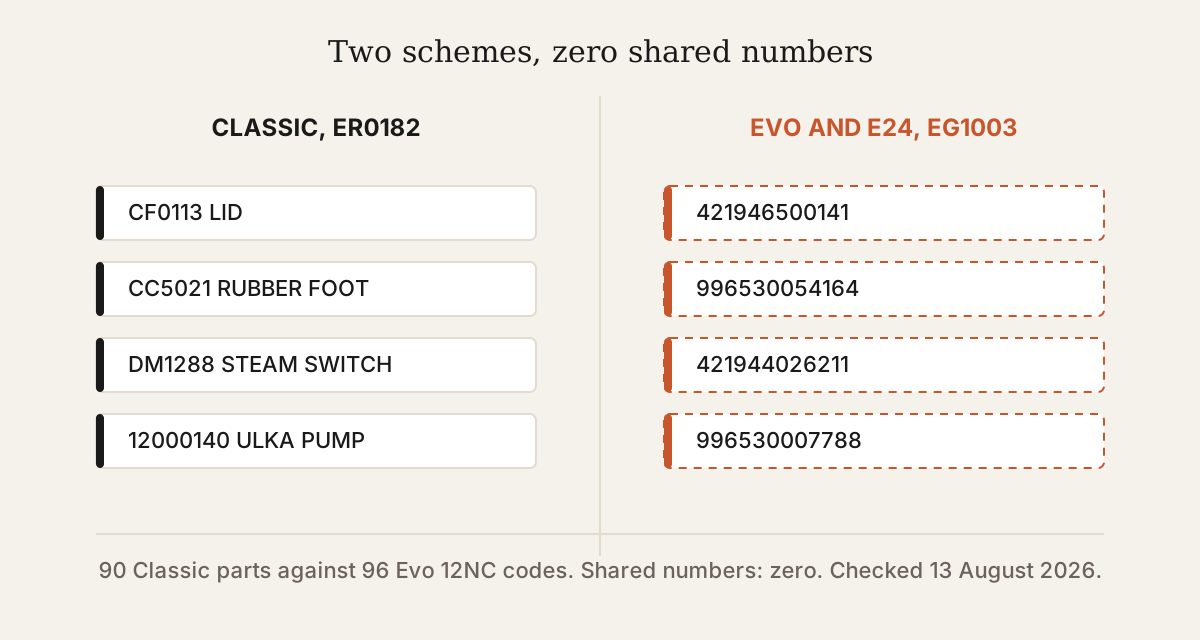
The manual covers the Classic 2019 and the Classic Evo Pro. It does not cover the older Gaggia Classic documented in the ER0182 parts diagram.
That older diagram carries no date on its face and uses a different part numbering scheme entirely. No published Gaggia document maps the two schemes to each other, so a part in the service manual’s scope cannot be traced back to the older machine from Gaggia’s own documentation.
It also states no OPV pressure setting and no adjustment procedure for one, despite carrying disassembly procedures and a torque table. Of five manufacturers checked on 13 August 2026, none publishes an OPV setting.
Why this document is unusual
Of five espresso manufacturers checked on 13 August 2026, Gaggia is the only one publishing a service manual openly.
The counting rule: a brand counts as publishing a service manual when a manufacturer-hosted or national-distributor-hosted document containing disassembly or repair procedures is reachable without a login. Breville, De’Longhi and Philips publish instruction books and no service manual. Rancilio was checked and excluded from the five because its technical portal requires a User ID and password. Rocket Espresso has no support section on its own domain.