Where the Gaggia Classic Wiring Diagram Is Published
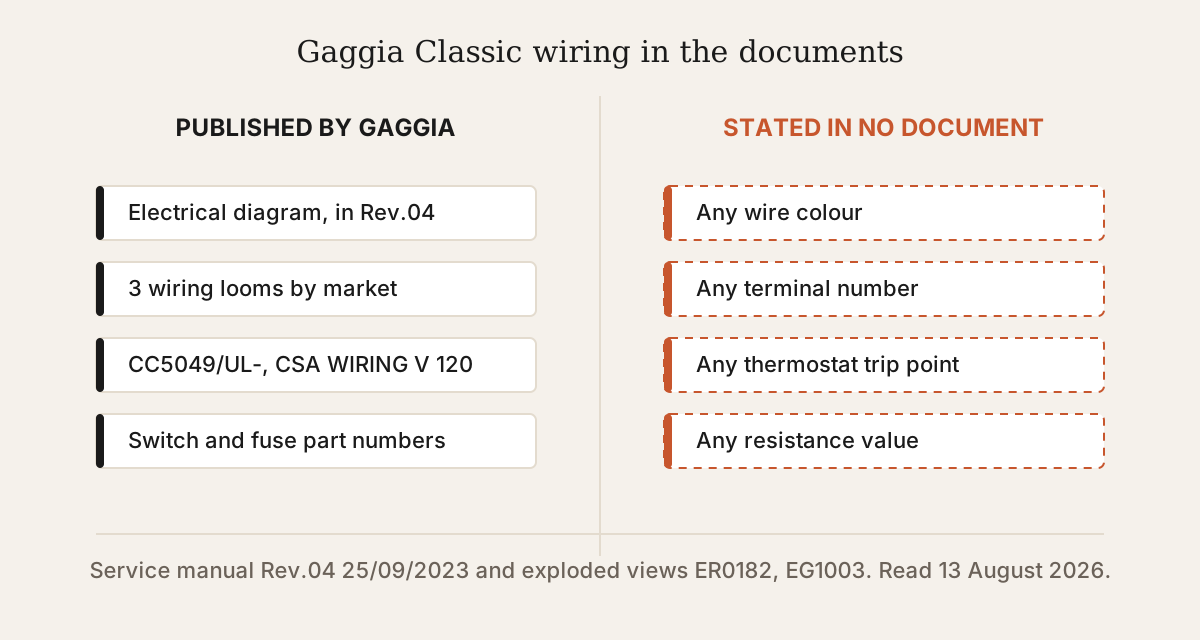
Gaggia publishes an electrical diagram inside its service manual, revision Rev.04 25/09/2023. The wiring loom is a market-specific part with three named assemblies.
The Gaggia Classic electrical diagram is published inside the service manual, revision Rev.04 25/09/2023, which Gaggia North America links from its own manuals page, and it is a drawing rather than a table.
The document that contains it
Source: GAGGIA CLASSIC 2019 & CLASSIC EVO PRO service manual, Rev.04 25/09/2023. Linked from gaggia-na.com/pages/gaggia-classic-pro-evo-e24-manuals.
That document also contains a technical specification table, a hydraulic circuit diagram, disassembly procedures, a tightening torque table and a troubleshooting matrix.
Of the five espresso manufacturers examined on this site, Gaggia is the only one that publishes a service manual at all. Counting rule: a manufacturer counts as publishing one when a document titled as a service manual is reachable from a manufacturer or national distributor domain without a login. One of five, checked 13 August 2026.
The wiring loom is a part, and it is market-specific
Three wiring assemblies are named in the exploded view Exp.EG1003 Rev.01 - 06/07/23, and they differ by market voltage.
| Assembly as named in the document |
|---|
WIRING CLASSIC EVO S.O.230V ASS |
WIRING CLASSIC EVO 100-120V ASS |
WIRING CLASSIC EVO 220-230V ASSY |
The older Classic parts diagram ER0182 names two more, at position 100:
| Pos | Article number | Description |
|---|---|---|
| 100 | CC5049/UL- | CSA WIRING V 120 |
| 100 | CC5062 | 230 V (9307-INOX) WIRING |
Wiring differs by market rather than by generation. A diagram read against a 230 V machine describes different loom part numbers from the same diagram read against a 120 V machine.
The electrical components the parts diagrams do name
Source: ER0182, the older Classic parts diagram, transcribed from its text layer.
| Pos | Article number | Description |
|---|---|---|
| 12 | DM1288 | STEAM TEMPERATURE SWITCH |
| 15 | GG0064 | BRACKET FOR THERMOFUSE |
| 16 | DM1040 | FUSE |
| 17 | DM1168 | COFFEE TEMPERATURE SWITCH |
| 56 | DM1475 | MAIN SWITCH-220-240 VOLTS |
| 62 | 183911050 | BLACK POWER CABLE SCHUKO L=1200 |
| 62 | CF0292/USA | POWER CABLE 2X16 AWG USA BLACK |
| 62 | CF0292/ILX | 3 X 1 ISRAEL POWER CABLE |
Position 62 is one callout with several part numbers behind it, one per market power cable. The Evo parts list adds a further electrical assembly, CPU+SW ECO-SWITCH RELE 20MIN 230V ASSY, which is the standby board behind the 20 minute automatic shut-off that separates the Evo Pro from the Classic Pro.
What no Gaggia document states in text
The diagram is a drawing. Its connections do not exist as text anywhere in the published set, though some of the components it connects are specified in the parts lists.
- No wire colours. Nothing in any of the six Gaggia documents lists a colour against a terminal.
- No terminal numbering. The connections exist as lines on a drawing, not as a table of from and to.
- No continuity or resistance values for the switches, the thermostats or the thermal fuse.
- Thermostat trip temperatures are stated, but in the parts list rather than the diagram. The older Classic diagram
ER0182names aCOFFEE TEMPERATURE SWITCHand aSTEAM TEMPERATURE SWITCHby part number with no rating. The Evo and E24 exploded viewExp.EG1003 Rev.01 - 06/07/23states both:THERMOSTAT 145°C M4X0.7 PLASTIC CASEat position 218 andTHERMOSTAT 107°C M4X0.7 PLASTIC CASEat position 219.
The wiring PDF contains no text objects at all. Opened with PyMuPDF 1.26.5 on 13 August 2026, the single page returns 3,810 vector drawing objects, zero font objects, zero embedded images and zero characters in every extraction mode offered. Its producer string reads CoCreate OneSpace Designer Drafting 2006 and its creation date is 26 October 2009. It is a CAD export in which every stroke, including any lettering, is line geometry.
This page does not transcribe the diagram, because the diagram’s payload is drawn rather than written, and a transcription made by reading a drawing is a claim about a picture rather than a quotation from a document. It states which document holds it, which revision, and where that document is published.
Why this question ends up on forums
Checked 13 August 2026, the first page of results for this query is held by Facebook, Reddit, two coffee forums, Pinterest and a document-sharing site, with one retailer page and one national distributor page among them.
The manufacturer document exists and is free to download. The gap is not that the information is unpublished. It is that the published form is a drawing inside a service manual, and a drawing does not answer a question typed into a search box.