What Two Component Makers Publish About Fitment, and What They Decline To
Two of the five espresso brands publish a parts document, and both name their component maker. IMS names Rocket machines by model, publishes every dimension, and still will not say a basket fits one.
Espresso machine makers buy their pumps, baskets and screens from component manufacturers, and those component makers publish documents of their own. The question is whether that second layer of documentation answers what the machine makers do not: which part fits which machine. It does not, and on the clearest available example the component maker declines the question explicitly rather than leaving it unaddressed.
No published source states that a given basket fits a given machine. Neither the machine makers nor the component makers assert it. What follows is what each of them does publish, and where the line falls.
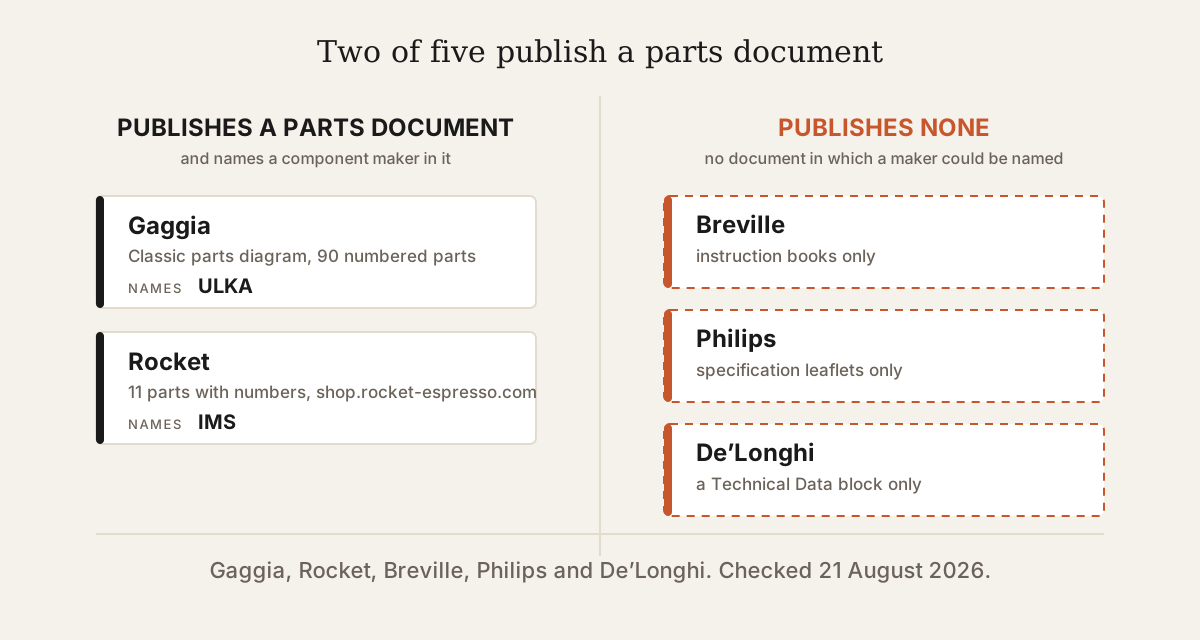
Two of five publish a parts document, and both name their component maker
Counting rule, so the figure is reproducible: a brand counts as publishing a parts document when a document carrying part numbers, issued by the brand and identifiable as theirs from its own imprint, was located and read. Checked 21 August 2026.
| Brand | Parts document | Component maker named in it |
|---|---|---|
| Gaggia | Classic parts diagram, 90 numbered parts | ULKA |
| Rocket | 11 parts with numbers, shop.rocket-espresso.com | IMS |
| Breville | none, instruction books only | none possible |
| Philips | none, specification leaflets only | none possible |
| De’Longhi | none, a Technical Data block only | none possible |
Two of two brands that publish a parts document name a component maker. Zero of three that publish none could. The absence in the lower three rows is structural. There is no document in which a maker could have been named, so it is not evidence that those brands conceal their suppliers.
Gaggia’s diagram lists 12000140 ULKA PUMP EP5/S GW 230V-50HZ and 12000142 ULKA PUMP EAP5/S 120V-60HZ. Rocket’s shop lists IMS Competition Series filter basket under part M619906554. In both cases the machine maker’s own document is what names the component maker, and that direction matters: the linkage runs from machine to component, published by the machine brand.
What the component makers publish about themselves
CEME, which has owned the ULKA brand since 2006, publishes the pump and not the machine. Its documents give voltage, wattage, maximum pressure of 15 bar, flow rate of 650 cc per minute, duty cycle and fittings. Its own coffee application page names no machine manufacturer and no model, describing its pumps only as mounted on coffee machines for home use.
IMS publishes considerably more, and stops at the same line. On its own site IMS carries a brand index of more than fifty machine makers, Gaggia and Rocket among them, and its Rocket page names the models directly: Appartamento, Mozzafiato, Giotto, and the R58 or Cinquantotto. Its product pages carry full dimensions, Border 70 mm, Body 60 mm, Height 26 mm, with a tamper diameter of 58 or 58.4 mm.
IMS links no part code to any model. Its Rocket page states that all Rocket machines use a standard commercial 58 mm group head, and directs the reader to select on group size, tamper diameter and cup capacity. The dimensions are the compatibility statement, and the model names are context for finding the right dimension.
Why a component maker declining the claim is the stronger finding
A machine manufacturer that publishes nothing about cross-model fitment leaves the question open. A component manufacturer that names your machine by model, publishes every dimension of the part, and still will not say the part fits the machine has answered a different question: it has told you what determines fit.
Fit is set by group type and by dimension. A 58 mm figure is a diameter and not a fitment. Two baskets can share a border diameter and differ in body diameter, height, or the geometry of the group they seat into, and the maker who cuts them to a tenth of a millimetre is the party best placed to know that a shared number is not a shared fit.
This is a finding about two component makers and it is stated with its denominator. Two of two brands publishing parts documents name a maker. Two component makers were examined. It is not a general statement that component manufacturers never publish fitment, and four more would have to be checked before that sentence could be written.
What this means when buying a part
The documents support three things and not a fourth.
- A part number identifies a part. Where two machines list the same number in the same catalogue, that is a documented fact about the documents.
- A dimension identifies a size. Where IMS states 58 mm, that is a measurement of the basket and not a statement about your machine.
- A group type identifies a family. Where IMS states that Rocket machines use a commercial 58 mm group, that is a statement about the group and not about a specific part in a specific machine.
- Nothing published states that a specific aftermarket part fits a specific machine model. That claim exists in the market, and it is made by sellers rather than by makers.
Frequently asked questions
Does IMS say which of its baskets fit a Rocket Appartamento?
No. IMS names the Appartamento on its Rocket page and states that Rocket machines use a standard commercial 58 mm group head, then directs the reader to select by group size, tamper diameter and cup capacity. It publishes the dimensions of each basket and does not map a part code to a machine model.
If two parts are both 58 mm, are they interchangeable?
The documents do not say so. A 58 mm figure is one dimension of a part that has several, and IMS publishes border diameter, body diameter and height separately for exactly that reason. No manufacturer document examined states that a shared diameter implies a shared fit.
Why does Gaggia name ULKA but Breville name nobody?
Because Gaggia publishes a parts diagram and Breville does not. Breville’s instruction books specify a 54 mm portafilter and carry no parts list, so there is no document in which a component maker could appear. The difference is what each brand publishes, not what each brand uses.
Where can the original documents be read?
Gaggia’s parts diagram and Rocket’s spare parts catalogue are manufacturer-issued documents identified by their own title pages and imprints. Rocket’s APPARTAMENTO Espresso Machine, Spare Parts Catalogue, Ed.04.2023 carries a Rocket Espresso Ltd copyright line, and the copies located are hosted by retailers rather than by Rocket. A document is identified by what it says about itself, not by the site that serves it.