What None of Five Espresso Manufacturers Publishes
Five espresso manufacturers were checked for cross-model compatibility, brew temperature and OPV settings. None of the five publishes any of the three.
Three things that buyers routinely look for are published by none of the five espresso manufacturers examined: cross-model part compatibility, brew temperature at the group, and OPV pressure settings.
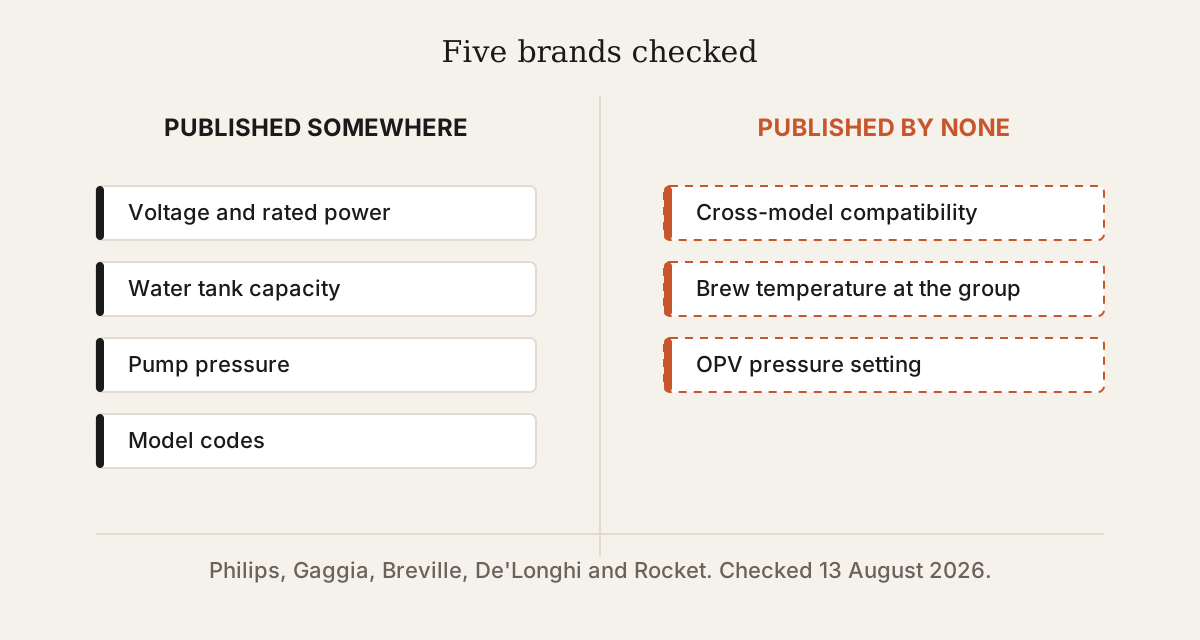
The five brands checked, and what each publishes
Philips, Gaggia, Breville, De’Longhi and Rocket Espresso were checked on 13 August 2026 against their own published documents.
The counting rule, so the figure is reproducible: a brand counts as publishing an attribute when the attribute appears in a document hosted by the manufacturer or its national distributor, reachable without a login. Retailer re-hosts do not count. The five brands checked are Philips, Gaggia, Breville, De’Longhi and Rocket Espresso. Rancilio was checked and excluded from the five because its technical portal requires a User ID and password.
| Attribute | Philips | Gaggia | Breville | De’Longhi | Rocket |
|---|---|---|---|---|---|
| Model codes | Yes | Yes | Yes | Yes | Partial |
| Voltage and rated power | Yes | Yes | Yes | Yes | Yes |
| Pump pressure | Yes | Yes | Yes | Yes | No |
| Water tank capacity | Yes | Yes | Yes | Yes | Yes |
| Dimensions | Yes | Yes | No | Yes | No |
| Portafilter size | No | No | Yes | No | No |
| Part numbers | No | Yes | No | No | Retailer only |
| Service manual | No | Yes | No | No | No |
| Cross-model compatibility | No | No | No | No | No |
| Brew temperature | No | No | No | No | No |
| OPV setting | No | No | No | No | No |
Cross-model compatibility
No manufacturer of the five states that a component from one model fits another.
The nearest thing to it is a shared dimension. Breville states a 54mm portafilter in the BES870, BES878 and BES840 instruction books, checked 13 August 2026. Three machines documented at 54mm is three machines documented at 54mm, and none of those books says a basket lifts from one into another.
There is one route to a compatibility statement that does not require inference, and it needs a manufacturer to publish part numbers. Where two models list the same part number in the same published catalogue, that is a documented fact. Of the five brands, only Gaggia publishes part numbers at all, and its own two parts documents use disjoint numbering schemes with a zero intersection, so even within Gaggia the route reaches across models in one document and not between documents.
Brew temperature at the group
No brand of the five states a brewing temperature as a specification.
Philips comes closest and does not get there. The EP5447/90 leaflet, version 9.9.1 issued 2023-08-16, carries the footnote Based on 70-82 C, attached to a marketing claim about temperature and aroma rather than presented as a specification of the machine.
Breville states PID temperature control in its instruction books without giving a target temperature. Gaggia’s service manual, revision 04 dated 25 September 2023, gives a test condition of Water temperature in tank: 23 C (+/-2 C), which is a starting condition for a measurement procedure and not a brew temperature.
OPV pressure setting
No brand of the five publishes an over-pressure valve setting or an adjustment procedure, including Gaggia, which publishes a full service manual with disassembly procedures and a tightening torque table.
What Gaggia’s service manual does state is a maximum: The machine hydraulic circuit can reach maximum pressure of 11 +1/-0,5 bar. That sits alongside a separate pump rating of 15 bar in the same document’s specification table. The two figures answer different questions and collapsing them into one would misstate both.
The documents these findings rest on
Every statement above was checked against a named published document.
| Brand | Document | Where |
|---|---|---|
| Philips | EP5447/90 leaflet, version 9.9.1, issue 2023-08-16 | documents.philips.com |
| Philips | EU Declaration of Conformity EDC 1008, DAP B.V., July 2026 | dam.versuni.com |
| Gaggia | Service manual, revision 04, 25 September 2023 | linked from gaggia-na.com |
| Gaggia | Parts diagram ER0182; exploded view Exp.EG1003 Rev.01 - 06/07/23 | linked from gaggia-na.com |
| Breville | BES870 USCM O22, BES878 US and ANZ I22, BES840 CA instruction books | assets.breville.com and breville.com |
| De’Longhi | Seven instruction manuals including ETAM29.51X 5713226261/12.14 | dls.delonghigroup.com |
| Rocket | Domestic Catalog; Appartamento Spare Parts Catalogue Ed.04.2023 | rocket-espresso.com; retailer hosted |
Why this absence is worth stating rather than filling
A specification that no manufacturer publishes cannot be sourced, and a page that supplies one anyway is supplying an inference.
The three attributes above are exactly where a reader is most likely to find a confident number somewhere online. The documents examined here do not support one. Where this site cannot cite a document, it says so.