Where De'Longhi Publishes Its Espresso Manuals
De'Longhi hosts manuals on its own document server at dls.delonghigroup.com. The URLs carry a language code and a numeric ID, and nothing else.
De’Longhi publishes its espresso machine manuals on its own document server at dls.delonghigroup.com, and the files download without a login.
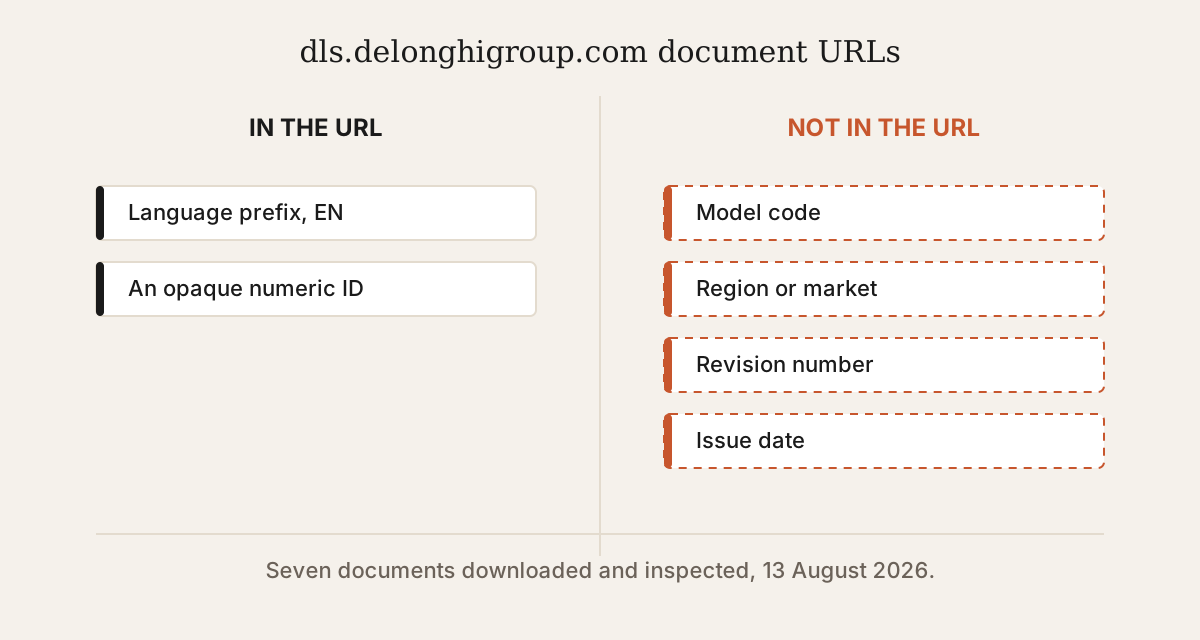
The document server, and what a URL looks like
A De’Longhi manual URL has the form dls.delonghigroup.com/files/docs/<n>/EN-<id>.pdf, where the only human-readable element is the language prefix.
https://dls.delonghigroup.com/files/docs/5/EN-5713229761.pdfThat file is the instructions for use for the ECAM35X.75. Nothing in the address says so. Seven documents were downloaded from this server and inspected on 13 August 2026, ranging from 1.9 MB to 11.3 MB.
What the URL does not tell you
The address carries a language prefix and an opaque numeric identifier, and omits the model, the region, the revision and the date.
| A citation needs | Is it in the URL? |
|---|---|
| Model code | No |
| Region or market | No |
| Revision number | No |
| Issue date | No |
| Language | Yes, as the EN- prefix |
This matters because the revision does exist, it is simply printed inside the document rather than in its address. The manual for the ETAM29.51X carries the stamp 5713226261/12.14 on its first page, which is the document number followed by a December 2014 date. A workable citation therefore names the document from its own front matter and uses the URL as a locator rather than as an identifier.
The trap when checking whether a document exists
Guessing at document IDs returns HTTP 200 with a 6,657 byte page rather than a 404, so a status code check reports every guess as a success.
Adjacent IDs were requested on 13 August 2026. EN-5713229760, EN-5713229762 and EN-5713200000 all returned status 200 at 6,657 bytes, while the one known-good ID returned 6,772,585 bytes of application/pdf. Existence has to be tested by response size or content type, never by status code alone.
Why the manuals cannot be enumerated
The per-model support pages are reachable but rendered in JavaScript, so the document links are not present in the page source.
delonghi.com/en-us/manuals, the coffee and espresso category page, and a model support page such as delonghi.com/en-us/s/ECP3620 all return HTTP 200 when requested with ordinary browser headers, checked 13 August 2026. An earlier automated request returned 403, which was bot filtering rather than an access restriction. Extracting the PDF links from those pages needs a rendering browser.
What De’Longhi does not publish
No parts diagram, no part numbers and no service manual were found on any De’Longhi domain, checked 13 August 2026.
The specification tables De’Longhi does publish are the most complete of the five brands examined, covering voltage, absorbed power, pressure, tank capacity, dimensions, cord length, weight and bean capacity in a single block. What sits beside that completeness is an absence: nothing in these documents identifies a replaceable component, and nothing addresses whether a part from one model fits another.