Where To Get Espresso Machine Parts, Across 28 Brands
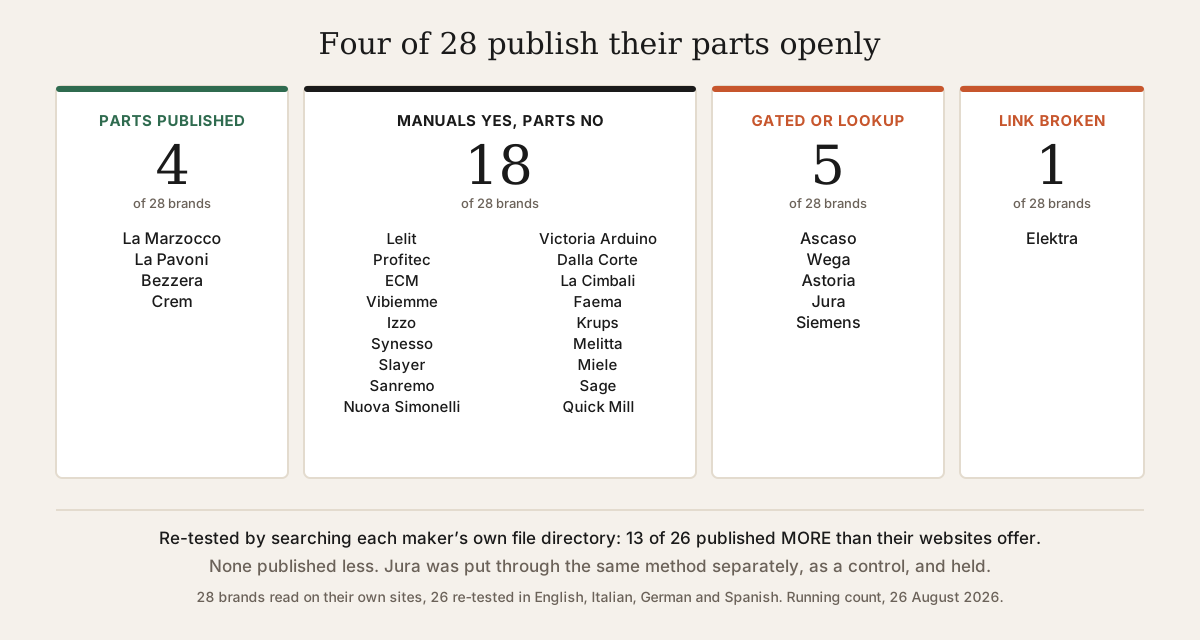
We checked what 28 espresso brands publish about their own parts, then checked again by a second method. Thirteen of the 26 re-tested so far publish more than their own websites offer.
The honest answer to where you get parts is that it depends on the brand, and that the obvious way to find out is wrong.
We assessed 28 espresso brands by reading each maker’s own website: its menus, its support pages, its downloads section. Then we checked them again by a different method, searching each maker’s own file directory rather than its navigation. As of 26 August 2026 we have re-tested 26 of the 28, and 13 of those moved. Every one moved the same way, toward a larger document set, and not one brand turned out to publish less than we had recorded. The re-test is continuing, so that figure is a running count and not a final one.
That is the finding. The list below matters, but the method behind it matters more, because the first method is the one every buyer uses and it understates what manufacturers publish.
Why reading a maker’s website understates what it publishes
A manufacturer’s site menu is built for buyers. It leads to products, dealers and a contact form. The parts a technician needs are usually on the same server and are simply not linked from anywhere a buyer would look. They are filed under names like Catalogo-ricambi-macchine or ESPLOSO, in Italian, German or Spanish, and a menu written for shoppers has no reason to point at them.
So we ran every brand a second time as a site-restricted search of its own domain, in those languages as well as English. Checked 22 August 2026.
Bezzera is the clearest case, and it is the one that overturned our own strongest claim. We had written Bezzera up as the hardest refusal in this corpus, harder than Jura, on the ground that its portal gates user manuals as well as parts. That was wrong. Bezzera publishes spare parts catalogues openly at a public directory, no login, with maker document codes, revisions and editions. We read one: eleven pages, 136 part numbers, tables of position, code and description. It also carries something no other catalogue in this corpus does, which is a split by build date, so the same model has different parts depending on when it was made.
Quick Mill publishes an exploded diagram that is linked from nowhere. Its product pages offer a form. The diagram sits in the uploads directory under an Italian filename and is reachable only by search.
Nuova Simonelli and Victoria Arduino both looked like brochure-only brands on their Italian sites, behind a form asking for name, company and email. Their United States arm publishes an open archive covering both marks, with user manuals, spec sheets and a browsable catalogue of part numbers, no form and no login.
The control, and why it belongs here
A more aggressive search that finds more of everything is not evidence of anything. So we pointed the same method at the brand our corpus most depends on being right about.
Jura is the headline non-publisher here. It publishes user manuals freely and puts parts behind a lookup that answers only if you already have the appliance’s article number. We ran the site-restricted pass against jura.com and its United Kingdom, German and Swiss domains, in German as well as English.
It held. The one promising find, a path named technical documentation, is a three-page installation sheet: what ships in the box, ambient temperature range, the connections a customer must have made before the technician arrives. Across the whole document the word service appears once, and it refers to the visiting technician. No parts list, no exploded view, no wiring diagram.
That is what makes the thirteen credible. The method was applied to the row most likely to embarrass us, and the row survived.
The four ways a maker handles its own parts
| How the maker handles parts | Brands |
|---|---|
| Published openly, parts included | La Marzocco, La Pavoni, Bezzera, Crem |
| Manuals or specifications open, parts withheld | Lelit, Profitec, ECM, Vibiemme, Izzo, Synesso, Slayer, Sanremo, Nuova Simonelli, Victoria Arduino, Dalla Corte, La Cimbali, Faema, Krups, Melitta, Miele, Sage, Quick Mill, Ascaso |
| Behind a trade login or a lookup you must already have a number for | Wega, Astoria, Jura, Siemens |
| Documentation link broken on the maker’s own live site | Elektra |
Four of 28 publish parts documents openly. That is the number worth carrying.
Two entries in that last row deserve their own sentence. Elektra’s live site carries a navigation item labelled Technical Center that points at a domain now owned by a wood veneer company, where the path returns a 404. And Faema prints, on page two of its own manual, a web address and a username and password for the group parts portal. The address it prints presents an expired security certificate, so a browser blocks the page before the published key can be used.
What the searches say, and what they do not
Three counts, kept separate, because two of them mean different things.
| Measurement state | Keywords |
|---|---|
| Measured, with a monthly figure | 11 |
| Measured and returned zero | 0 |
| Never measured at all | 13 |
Not one keyword came back measured at zero. Every phrase that looks like it has no demand is a phrase that was never measured, and those are different facts. A phrase nobody has measured is not a phrase nobody searches. espresso machine parts carries 3,600 a month and coffee machine parts 1,300, while where can i find spare parts for my coffee machine was never measured, despite appearing as a People Also Ask question on five of the six searches we ran.
Provider DataForSEO, Google Ads keyword planner, United States, English, read 26 August 2026. These are modelled figures and not observed traffic. They do not say how many people visited anything.
What to do with a part you need
Find your model’s own parts document first, where the maker publishes one. La Marzocco, La Pavoni, Bezzera and Crem publish theirs openly. That document is the only source that ties a number to your machine and it is the maker’s own.
Check whether the catalogue splits by build date. Bezzera’s does, and where a maker draws that line the model name alone is not enough to identify the part.
Where the maker gates parts, the serial number is usually the key that opens the conversation. Slayer asks for it by email. Siemens and Jura answer a model number and nothing else.
Treat a diameter as a starting point rather than an answer. No manufacturer document we examined across Gaggia, Rocket, Breville, Philips, De’Longhi and the brands above states that a shared diameter implies a shared fit.
How this list was built
Twenty-eight brands, each read on its own site, then re-tested by site-restricted search of the maker’s own domain in English, Italian, German and Spanish. 26 of the 28 re-tested as of 26 August 2026, of which 13 moved. Jura was put through the same method separately, as a control, and held. The re-test is continuing and this count is dated for that reason: an undated figure goes quietly wrong when the sample grows.
Two brands still come with a caveat we are not going to hide. Quick Mill’s specification sheet sits behind a form we did not submit, so we can say the document is asserted to exist and not what is in it. Crem’s catalogue is open and states that it lets you search a part number and see every model using it, which would be the only such claim in this corpus, but the catalogue it links contains ice machines rather than espresso machines. We record that as a claim we could not confirm rather than as a capability.